Jarčja Dolina 1927 – 2013 Skofja Loka
Slovenian Painter
+32 478 22 65 64 | info@valentinasafarian.com

Jarčja Dolina 1927 – 2013 Skofja Loka
Slovenian Painter
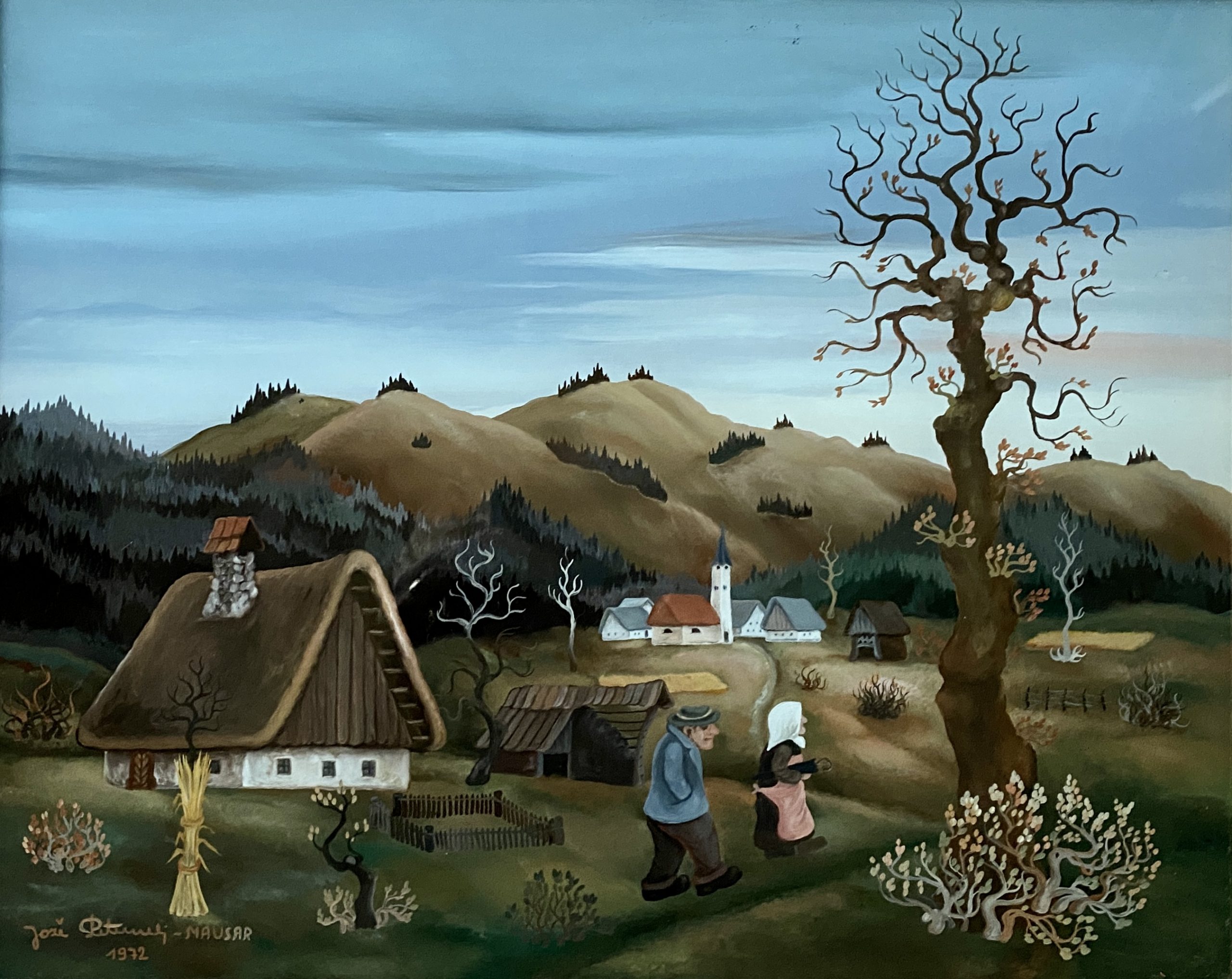
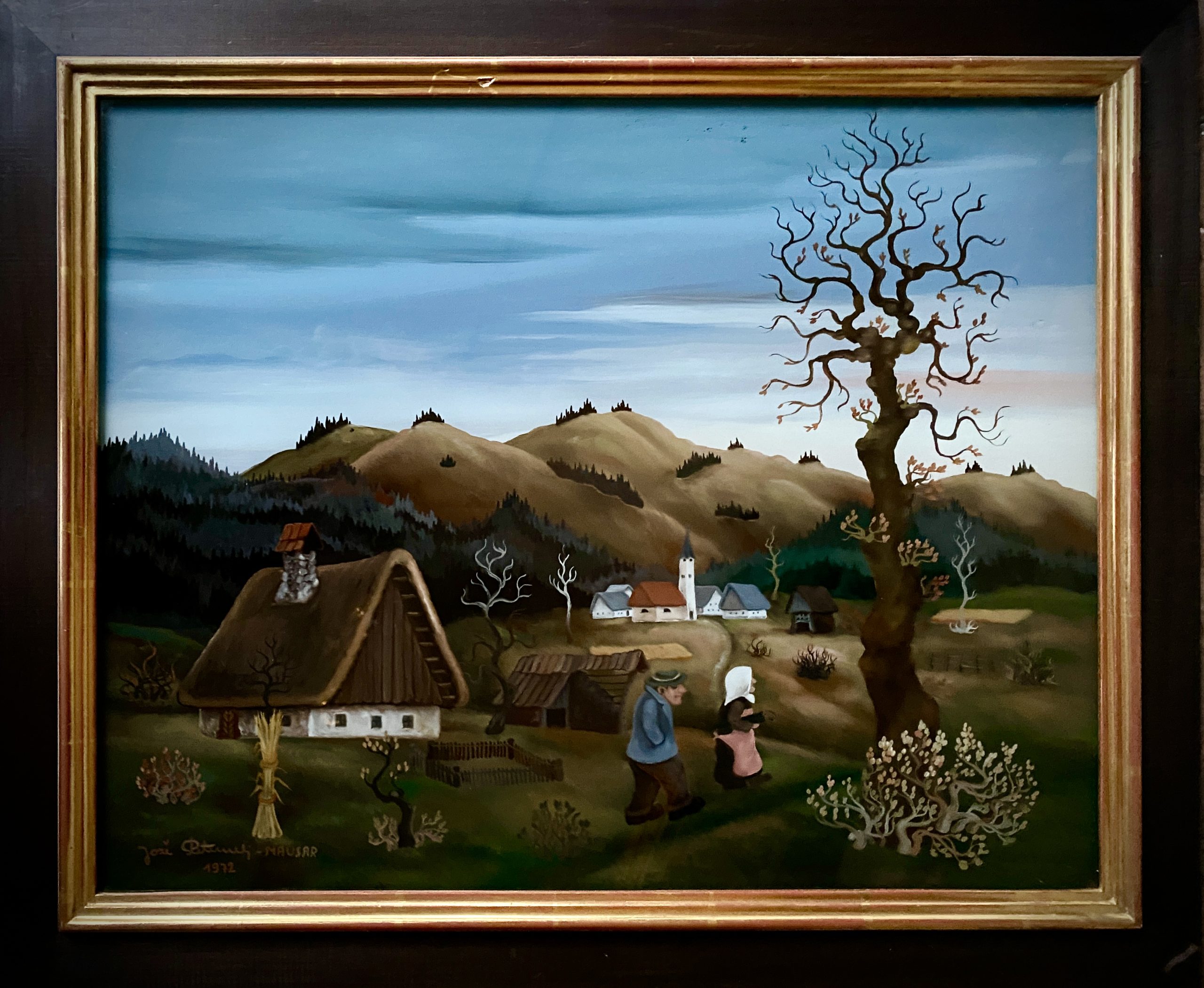
Jože Peternelj-Mausar was a Slovenian self-taught painter and writer, and one of the best-known representatives of Slovenian naïve art. He was born on 12 January 1927 in Jarčja Dolina near Žiri and grew up in a rural environment that would remain a central source of inspiration throughout his artistic career.
His artistic development unfolded against the rich cultural background of the twentieth century. The creative spirit of the 1930s, a decade marked by diverse political ideologies and the enduring influence of Surrealism in Europe, formed part of the wider artistic context of his generation. Surrealism increasingly gained international recognition, while artists incorporated its ideas into radical political and cultural visions, contributing to distinctive forms of magic realism.
After the Second World War, Peternelj-Mausar trained as a shoemaker and worked for the Slovenian footwear company Alpina. He began painting in the early 1950s and gradually developed a highly personal artistic language. In 1971, he left his employment and devoted himself entirely to art as a full-time independent artist.
Mausar’s paintings are deeply rooted in memories of his childhood and in the traditional rural life of the Žiri region and the Poljane Valley. Peasants, villagers, farmhouses, village gatherings and figures from everyday life populate his compositions. His landscapes are rarely merely descriptive; rather, they provide settings for narratives of ordinary existence, human relationships, hardship, joy and longing. His figures are often deliberately simplified and gently caricatured, giving his paintings a distinctive and immediately recognisable narrative character.
Working principally in oil, Mausar painted on canvas, wood and glass and produced a remarkably extensive body of work. His artistic language combines the directness of self-taught art with an imaginative approach to storytelling. His paintings preserve memories of a rural world and of traditions that were gradually disappearing, transforming personal recollection into a broader reflection on Slovenian life.
Mausar exhibited extensively both in Slovenia and abroad. His work was shown in his native region, Ljubljana and Škofja Loka, as well as internationally in Austria, Italy, Germany, France, Switzerland, Japan, the United States, Canada, Serbia, Poland, Bosnia and Herzegovina, Croatia and Norway, among other countries. His work was also presented at Museum Osnabrück in Germany. His first significant international recognition came in the 1960s, followed by exhibitions in Japan and throughout Europe. In addition to solo exhibitions, he regularly participated in group exhibitions in Slovenia and internationally.
His artistic achievements were recognised with numerous distinctions. In 1975, he received the Grand Prix de la Collection Winston for naïve painters, alongside distinctions associated with the international Prix Pro Arte and the Gallery of Self-Taught Artists in Trebnje. In 2007, he was named an honorary citizen of the Municipality of Žiri.
Alongside painting, Peternelj-Mausar was an accomplished writer. He published eight books, including novels and stories inspired by the rural world and the experiences of wartime and post-war Slovenia. He also contributed shorter literary works to respected literary magazines and anthologies. His literary and visual work share a common interest in ordinary people, memory, human experience and the traditions of rural life.
Jože Peternelj-Mausar died on 28 February 2013 in Škofja Loka. Today, he is regarded as an important figure in Slovenian naïve and self-taught art. His paintings are distinguished by their intimate connection to rural life, imaginative storytelling and recognisable, gently stylised figures, preserving a vivid artistic record of the world in which he grew up.
Zeedijk – Het Zoute 731, 8300 Knokke
Belgium
+32 478 22 65 64
info@valentinasafarian.com

© Copyright 2023 Valentina Safarian | Website by BEAUX SITES