1889 – Antwerpen – 1965
Belgian Painter
+32 478 22 65 64 | info@valentinasafarian.com

1889 – Antwerpen – 1965
Belgian Painter
Floris Jespers was born on 18 March 1889 in Antwerp into an artistic family where creativity was a way of life. His father, Émile Jespers, was a sculptor, and his younger brother, Oscar Jespers, would become one of Belgium’s leading modernist sculptors. From an early age, Floris displayed exceptional talent in both music and the visual arts. He supported himself as a cellist while studying at the Royal Academy of Fine Arts in Antwerp.
During the First World War, Jespers discovered his true artistic voice. A decisive meeting with the avant-garde poet Paul van Ostaijen in 1915 marked a turning point in his career. Together they became part of a new generation of artists and intellectuals determined to break with academic tradition. Jespers joined the progressive Antwerp artists’ circle De Bond zonder Gezegeld Papier and contributed to influential modernist journals such as Ça Ira and Sélection. Through these artistic circles, he embraced the innovative ideas of Cubism, Constructivism, and Expressionism, which profoundly shaped his artistic development.
His early work reveals a constant spirit of experimentation. Initially inspired by Rik Wouters and the vibrant colours of Fauvism, Jespers gradually incorporated the structural clarity and abstraction of Cubism, creating compositions that combined figurative subjects with bold geometric forms. His paintings from this period, including portraits, still lifes, and urban scenes, demonstrate a remarkable balance between rhythm, colour, and emotional expression. Masterpieces such as Bonjour Ostende and Adam en Eva exemplify his originality and formal inventiveness.
During the 1920s, Jespers established himself as one of the leading figures of Flemish Expressionism alongside Gust De Smet, Frits Van den Berghe, and Constant Permeke. Unlike many of his contemporaries, however, he never confined himself to a single artistic movement. His oeuvre remained remarkably diverse, continually evolving in both subject matter and style.
His collaboration with Paul van Ostaijen extended beyond friendship into the field of book illustration, most notably for Bezette Stad, one of the defining publications of Belgian literary modernism. Although their personal and ideological paths later diverged, their partnership remains one of the most influential collaborations in twentieth-century Belgian art.
Jespers was equally accomplished in a wide variety of artistic disciplines. In addition to painting, he created etchings, linocuts, stained-glass windows, tapestries, murals, and monumental decorative works. His designs were exhibited internationally at the Paris Exposition of 1937 and the New York World’s Fair of 1939. In 1958, he completed large-scale murals for the Palace of the Belgian Congo at Expo 58 in Brussels.
A significant new phase began in the 1950s when Jespers travelled to the Belgian Congo. Inspired by the region’s brilliant light, vibrant colours, and everyday life, he developed a fresh visual language characterised by luminous palettes and elegantly stylised figures. His depictions of Congolese women, markets, and daily life are not documentary observations but poetic interpretations celebrating beauty, dignity, and harmony. These works reveal an artist who continued to reinvent himself throughout his career.
Floris Jespers remained artistically active until his death in Antwerp on 16 April 1965. Throughout his life, he combined technical mastery with an enduring curiosity and openness to new ideas, securing his place among the foremost pioneers of Belgian modernism.
Today, his works are represented in major public and private collections, including the Royal Museum of Fine Arts Antwerp, Mu.ZEE in Ostend, and M Leuven, which preserves an extensive collection of his graphic works. In 2005, Mu.ZEE honoured Jespers with a major retrospective exhibition, reaffirming his lasting importance as one of the principal figures of twentieth-century Belgian art.
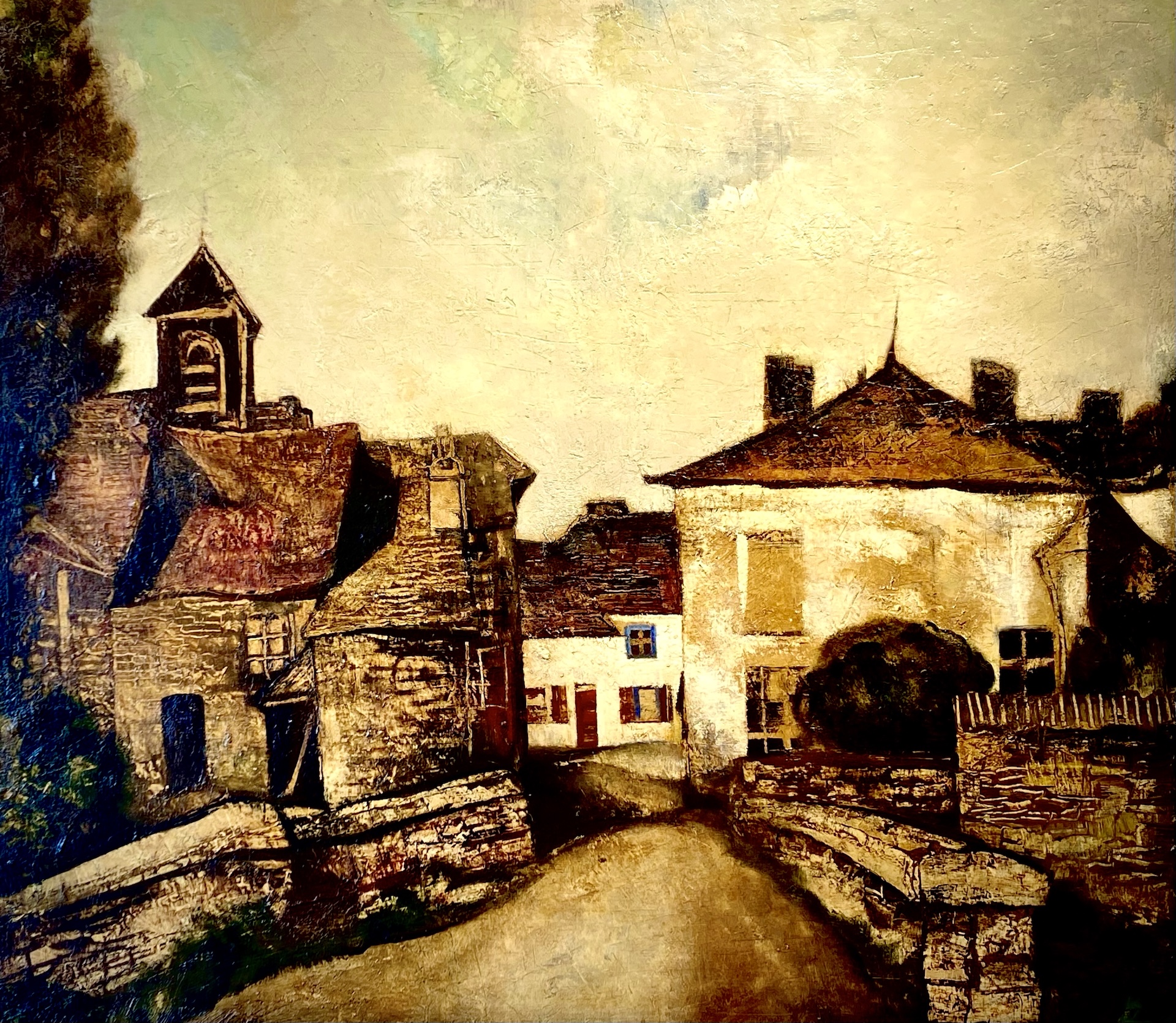
Village Scene in Wallonia (Straimont), 1933
In the early 1930s, Floris Jespers turned away from the vibrant, urban modernity that had defined much of his earlier work. The café scenes, theatrical portraits, and bold avant-garde experimentation gave way to a new, quieter phase: one rooted in the rhythm of rural life. Dividing his time between Antwerp, the Flemish coast, and occasional stays in the Ardennes, Jespers began to explore the serenity and structure of the regional landscape.
Village Scene in Wallonia (Straimont), painted in 1933, is a remarkable example of this shift. Created during one of his stays in the southern Ardennes, in villages such as Straimont or Jamoigne, Jespers focused here on the built environment of the countryside—simple houses, winding roads, and village squares rendered with quiet monumentality. The composition is executed in somber, earthy browns, with bold black contours that reinforce form and shadow, creating a visual language at once solid and introspective.
These village scenes from Wallonia carry a markedly different atmosphere from his Flemish landscapes: more muted in palette, more restrained in gesture, and charged with a reflective stillness. In their stylization and tonal harmony, such works recall the picturesque realism of Maurice Utrillo, whose popularity during this interwar period echoed a broader artistic desire for a “retour à la nature.”
Rather than sentimentalizing rural life, Jespers paints with architectural clarity and psychological depth. His view of the village is neither naïve nor nostalgic—it is structured, silent, and dignified. As such, this painting represents a key chapter in Jespers’ artistic evolution: a moment of inward focus, where form, memory, and place merge.
The work was exhibited in Antwerp in 1936 and reproduced in the 1943 monograph by L.G. Burssens (ill. 61). Decades later, it was once again brought into focus during the 1989 retrospective exhibition organized by the Flemish Ministry of Culture at the Royal Museum of Fine Arts in Antwerp, where it was published in the accompanying catalogue on page 152 (illustration 78). Its inclusion in both early and later scholarly references underscores the painting’s lasting significance within the broader arc of Jespers’ artistic career.
Zeedijk – Het Zoute 731, 8300 Knokke
Belgium
+32 478 22 65 64
info@valentinasafarian.com
© Copyright 2023 Valentina Safarian | Website by BEAUX SITES