1904 – Bruges – 1885
Belgian Painter
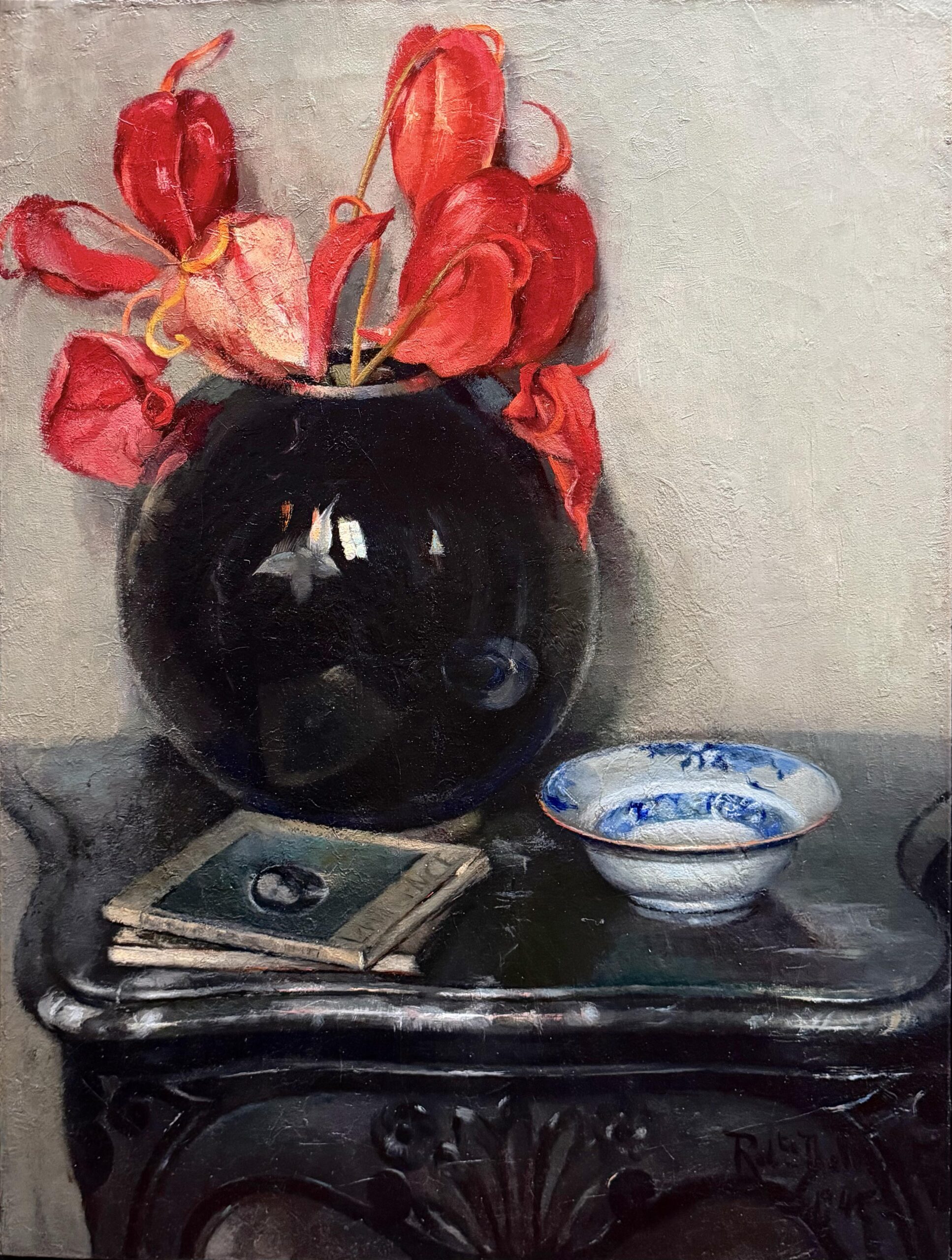
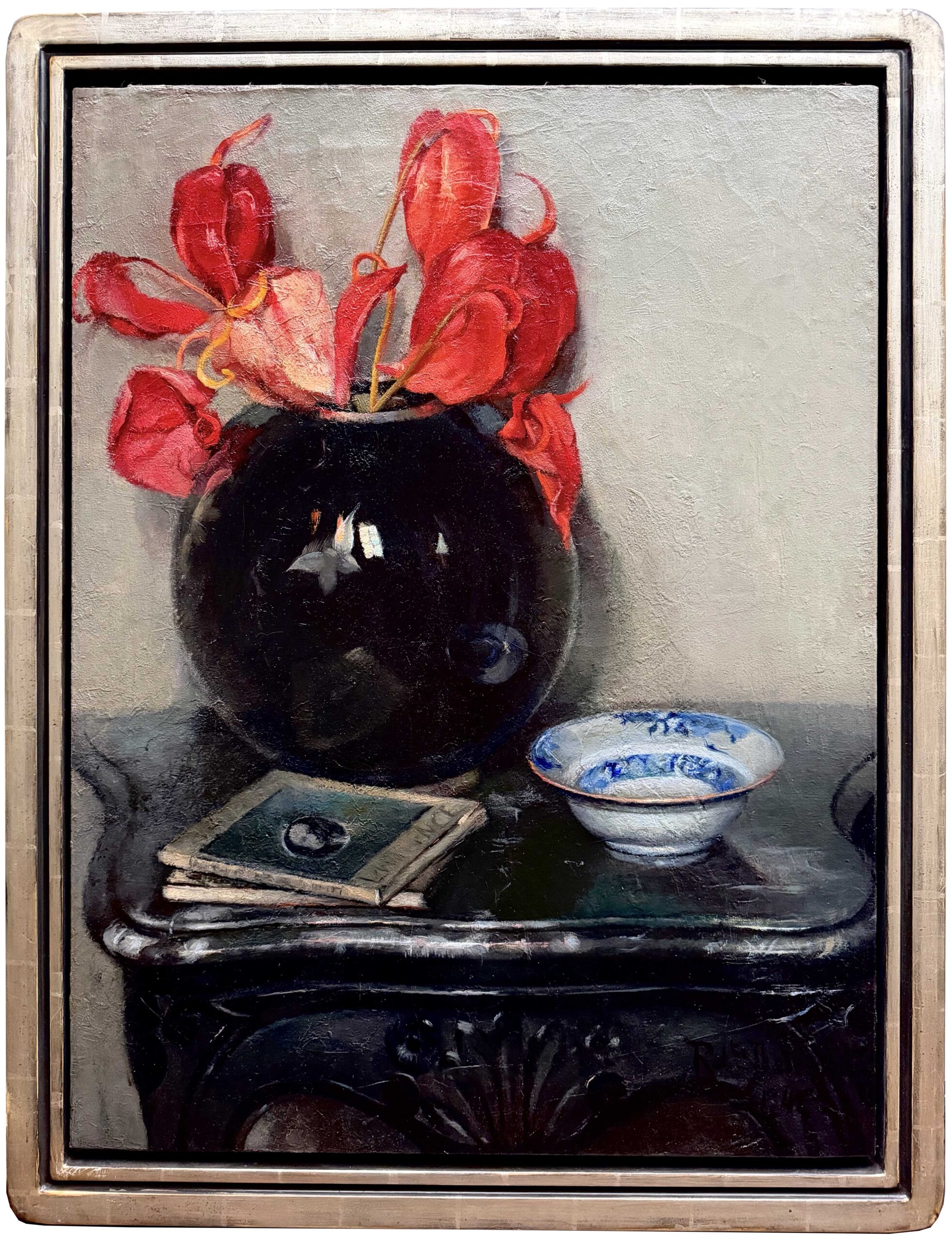
The Black Vase
Roberte Devooght, also known as Robertine Devooght, was born on 8 November 1904 at Witte Leertouwersstraat 22 in Bruges, Belgium, as the only child of Charles Devooght, a butcher, and Alpais Cordula Van Hulle, a milliner. She showed an early aptitude for the arts and pursued her studies at the Bruges Academy of Fine Arts from 1925 to 1928 under the guidance of Jef Van de Fackere. She continued her education with private lessons from Guillaume Van Strydonck in Brussels (1928–1929) and later studied at the Royal Academy in Brussels under Alfred Bastien (1929–1930). Between 1930 and 1932, she attended the Municipal Academy in Antwerp, studying with Felix Gogo and Isidoor Opsomer.
During this period, her father moved to the Langestraat, where a spacious studio was prepared for her, and she received strong support from her uncle Emile Dubois, who also gave her music lessons, and her aunt Alice Van Hulle. Devooght was drawn primarily to the human figure, excelling in portraits, nudes, and children’s heads, but also developed a deep interest in religious compositions, still lifes, and symbolic scenes. Her early academic training gradually gave way to a more personal and expressive style.
In the 1930s, she became the only woman member of the artistic club De Maffia, whose meeting place was in Café Sint-Ivo in Sint-Salvatorskoorstraat, Bruges. She taught drawing and painting at the Bruges Academy from 1940 to 1946. At the age of forty-four, she married her former student, the painter René Vandenberghe (1926–1980), with whom she frequently exhibited. Together, they lived in the so-called “Spookhuis” on Spanjaardstraat, near the Augustijnenbrug, where she produced some of her finest works.
Devooght created important large-scale group portraits, including the 1937 painting of the board of the cultural association Vlaamse Broederbond and the 1947 commission by the Royal Sint-Sebastiaansgilde of the Carmersstraat, depicting “The Oath” with eleven figures. The latter, measuring 3.5 × 2 meters, took six months to complete, including preparatory studies.
She moved several times later in life: in 1958 to the “Zes Engelenhuis” on Schaarstraat 54, in 1967 to a secluded residence on Kroonstraat 40–42, and in 1978 to a rural home in Loppem, where she died on 5 September 1979.
Devooght held numerous exhibitions in Bruges, beginning with her first in 1936 at Galerie San Salvador, followed by almost annual shows there and later at Galerie Memlinc. In 1954, she participated in a notable group exhibition of religious paintings at Galerie Unicum alongside her husband René Vandenberghe, Jules Rotsaert, and others. In 1970, the City of Bruges honored her with a retrospective at the Concertgebouw on Sint-Jacobsstraat, featuring approximately 175 works that traced the evolution of her artistic career. The exhibition drew wide public attention, including prominent figures such as Prime Minister Achiel Van Acker. On this occasion, the city acquired her 1966 painting Portrait of My Mother, a powerful and moving work.
In 1984, the richly illustrated monograph Robertine Devooght, Kunstschilderes was published by P. and E. Gervoyse-Devooght in Oostkamp, written by her granddaughter Eline Devooght as a tribute to her legacy.
Roberte Devooght is remembered as a highly talented artist who excelled in capturing the human figure with grace and precision. Her portraits reveal a charming elegance, while her later still lifes and symbolic compositions display a confident and personal style, free from strict academic conventions. She remains an important figure in 20th-century Belgian art, admired for her skill, dedication, and expressive vision.