Königswinter 1813–1879 Düsseldorf
German religious painter
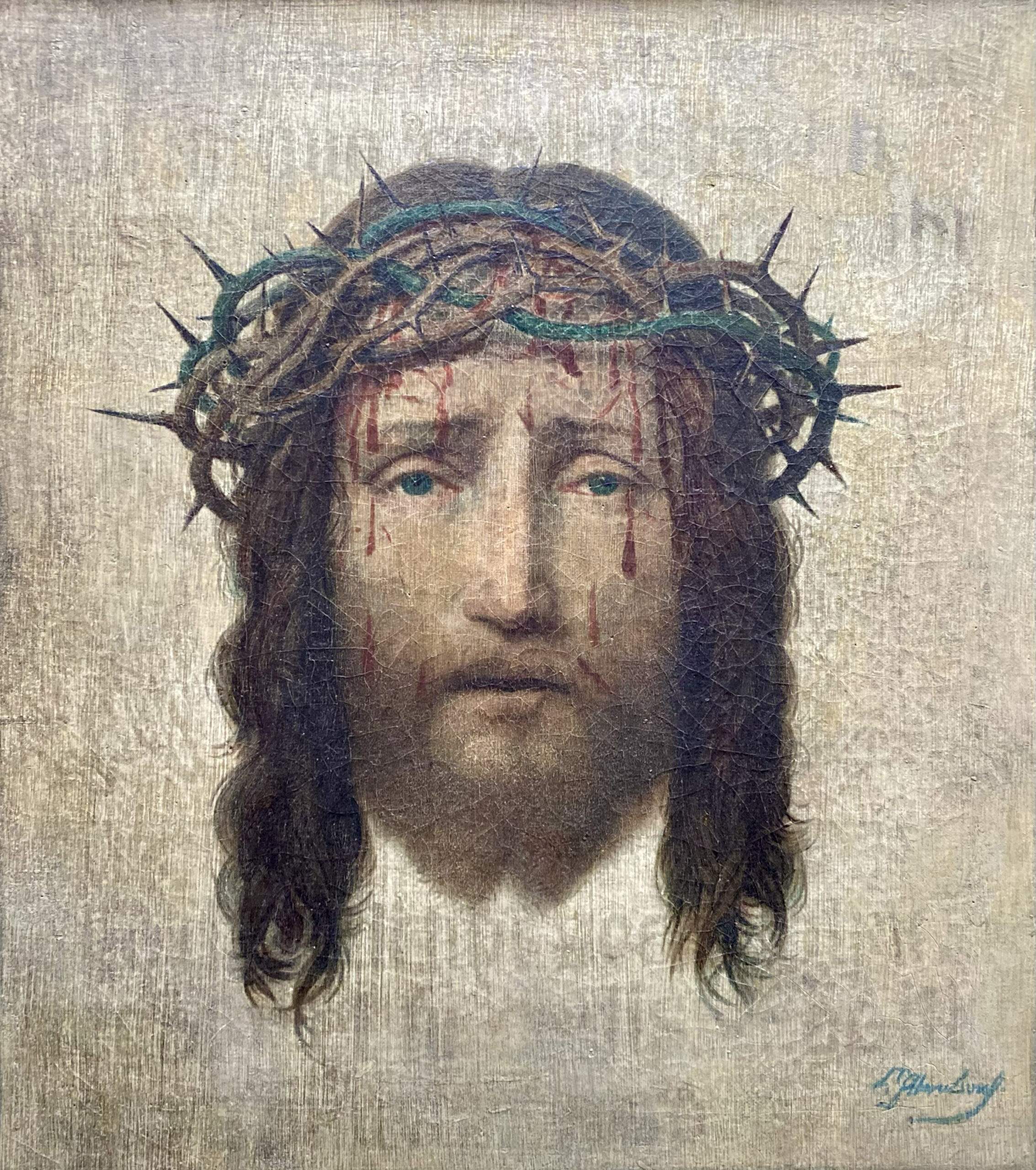

Jesus of Nazareth
Franz Ittenbach was a prominent German religious painter of the nineteenth century, closely associated with the Nazarene movement and the Düsseldorfer Malerschule. Born on 18 April 1813 in Königswinter, he devoted his artistic life almost entirely to sacred subjects, producing altarpieces, devotional images, and church decorations that were admired for their spiritual intensity, technical refinement, and idealized purity of form. He died in Düsseldorf on 1 December 1879 at the age of sixty-six.
Ittenbach began his artistic training under the painter Kaufmann before continuing his studies in Cologne with Franz Katz. In 1832, at just nineteen years old, he entered the Düsseldorf Academy of Fine Arts, where he also received private instruction from its influential president, Wilhelm von Schadow. There he became part of a circle of young artists deeply inspired by the Nazarene ideals of religious renewal in art, forming close bonds with Karl Müller, Andreas Müller, and Ernst Deger. Together, the four travelled through Germany, sketching, studying old masters, and developing a shared visual language grounded in early Renaissance models, clarity of line, and spiritual devotion.
Between 1839 and 1842 Ittenbach lived in Italy, where the Nazarene movement had first taken root decades earlier. The experience strengthened his commitment to religious painting and reinforced his admiration for Italian Renaissance art. After returning north, he spent time in Munich before finally settling again in Düsseldorf in 1849. From 1859 until his death he was an active member of the artists’ association Malkasten, an important cultural hub in the city.
Deeply devout by temperament, Ittenbach famously refused commissions for mythological or pagan subjects, concentrating almost exclusively on Christian imagery and ecclesiastical decoration. He approached major projects with ritual seriousness, often preparing himself through prayer, confession, and communion before beginning work. This spiritual discipline was reflected in the quiet dignity, luminous colour, and serene idealism that characterize his paintings of the Madonna and Child, angels, saints, and biblical narratives.
Among his most celebrated works were paintings for the church of St. Remigius in Bonn and another church dedicated to the same saint in Breslau (today Wrocław). A particularly notable Holy Family, dated 1861, was commissioned by Prince Liechtenstein for his private chapel near Vienna. His only major fresco was executed in 1844 for a church in Remagen, while the majority of his oeuvre is dispersed among Catholic churches throughout Germany. Although he occasionally painted portraits, including works such as Portrait d’un jeune couple, his reputation rested primarily on his altarpieces and devotional compositions, including subjects like Madonna auf den Wolken mit Engeln, Madonna and Child, and Mother of the World.
Highly esteemed during his lifetime, Ittenbach enjoyed considerable success in court circles, was elected to numerous European academies, and received many medals and honours. Today his works are preserved in museum collections in Berlin, Düsseldorf, Hannover, Münster, and elsewhere. His career and production are documented in major reference works, including E. Bénézit’s dictionary of artists.
Franz Ittenbach remains a significant figure of nineteenth-century German religious art—a painter whose unwavering faith, Nazarene ideals, and refined academic training combined to produce images of lasting devotional power and lyrical beauty.