Brussels 1827 – 1888 The Hague
Belgian Painter
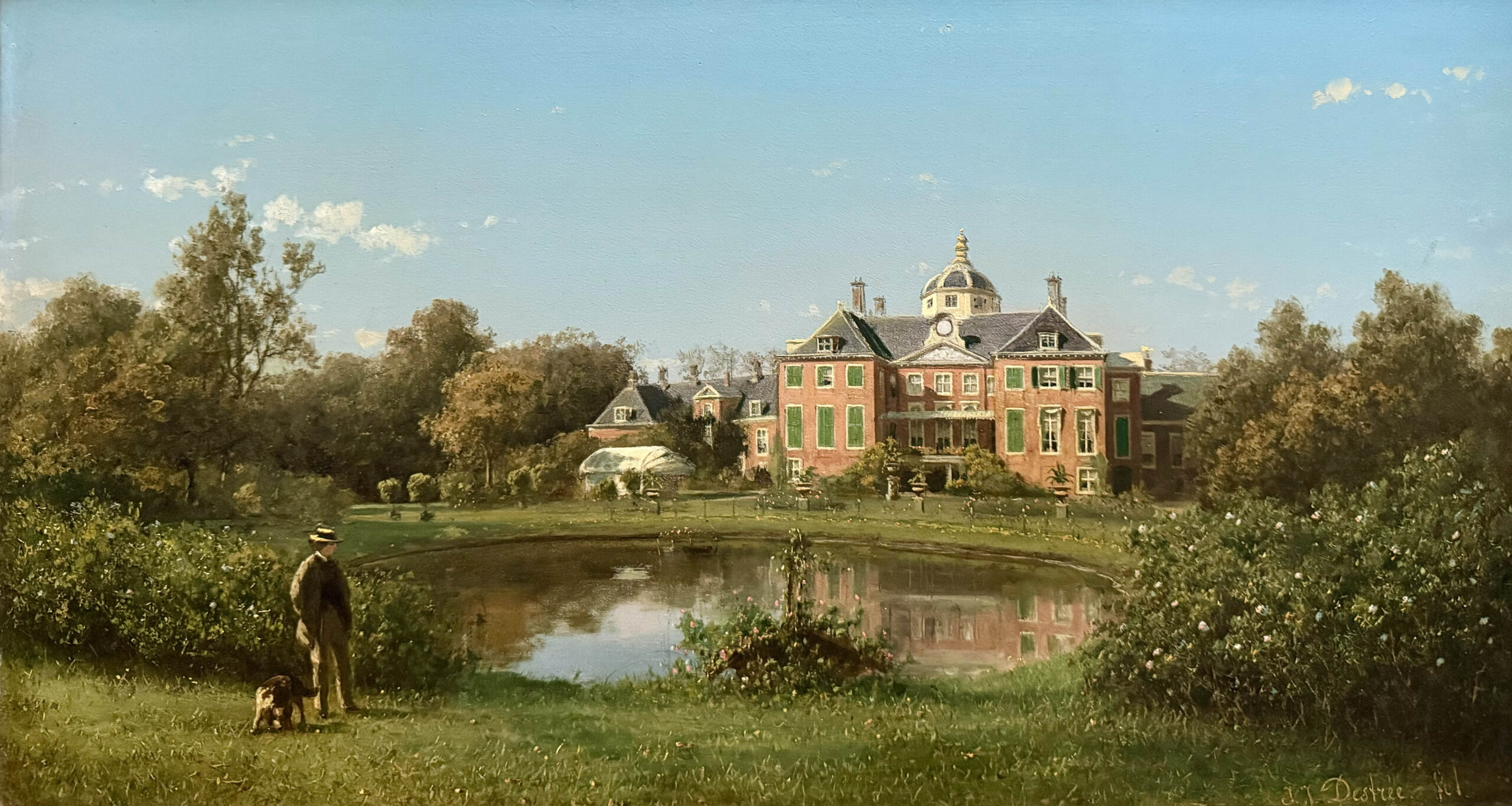
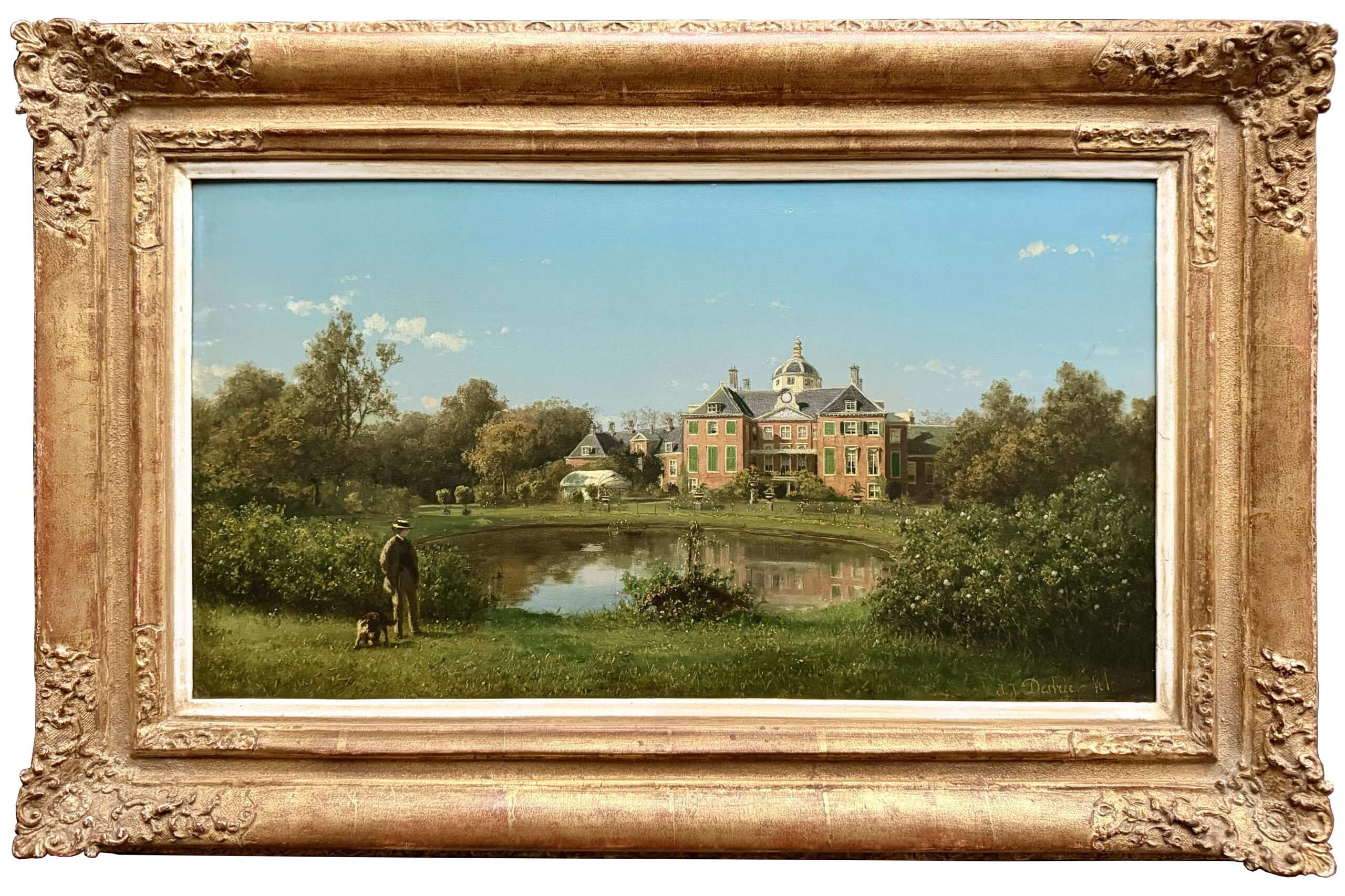
Garden View of the Royal Palace Huis ten Bosch, The Hague
Johannes-Joseph Destrée (Laeken, 27 March 1827 – The Hague, 17 March 1888) was a Belgian painter renowned for his landscapes and beach scenes, executed in a style closely related to Romanticism. Born in Laeken, near Brussels, he would spend most of his professional life in the Netherlands, where he made a significant contribution to the artistic life of The Hague.
Destrée received his training at the Drawing Academy in The Hague under the guidance of the respected masters Andreas Schelfhout and Bartholomeus Johannes van Hove (also known as B. J. van Hove). The influence of Schelfhout is particularly evident in his work, both in compositional structure and in the choice of motifs. Like his teacher, Destrée developed a strong affinity for winter landscapes and coastal scenes. His beach views, often inspired by Schelfhout’s example, were especially admired by his contemporaries for their expansive skies and refined atmospheric effects.
After completing his studies, Destrée settled permanently in The Hague. There, he became an active member of Pulchri Studio, the prominent artists’ society that played a central role in the city’s 19th-century artistic milieu. His integration into The Hague’s art scene positioned him within the broader tradition of Dutch Romantic landscape painting.
Although many of his works depict scenes in and around The Hague and Scheveningen, his artistic exploration extended further afield. He painted in the Dutch polders, the Veluwe, Oosterbeek near Arnhem, and Maastricht. He also traveled to Germany, working near Potsdam and in other locations; it is believed that he undertook several journeys there. His popularity was particularly notable in Germany, where his paintings were highly appreciated.
Destrée exhibited extensively throughout Belgium, the Netherlands, France, Austria, and Germany. Notably, he participated in the Paris Salon in 1882, further consolidating his international reputation during his lifetime.
His paintings are characterized by careful draftsmanship, balanced compositions, and a refined rendering of light and atmosphere. Whether depicting winter landscapes, rural views, or animated coastal scenes, his works reveal a disciplined technique combined with a Romantic sensitivity inherited from his teachers.
Johannes-Joseph Destrée died in The Hague on 17 March 1888, just shy of his sixty-first birthday.
Today, his works are preserved in both private and public collections. Paintings by Destrée are held in institutions including the Kunstmuseum Den Haag, the Frans Hals Museum, the Royal Museums of Fine Arts of Belgium, the Teylers Museum, and the Stedelijk Museum Amsterdam, reflecting his enduring legacy within 19th-century European landscape painting.