1871 – Ixelles (Brussels) – 1950
Belgian Painter
+32 478 22 65 64 | info@valentinasafarian.com



1871 – Ixelles (Brussels) – 1950
Belgian Painter
Jacques Madyol, also known as Jacques Madiol, was a Belgian painter whose versatile oeuvre encompasses portraits, genre scenes, landscapes, still lifes and figure studies, as well as watercolours and illustrations. Born in Ixelles, Brussels, he was the son of the painter Adrien-Jean Madyol (Madiol). He studied at the Academy of Fine Arts in Brussels from 1893 to 1897, where he developed a strong grounding in the figurative tradition.
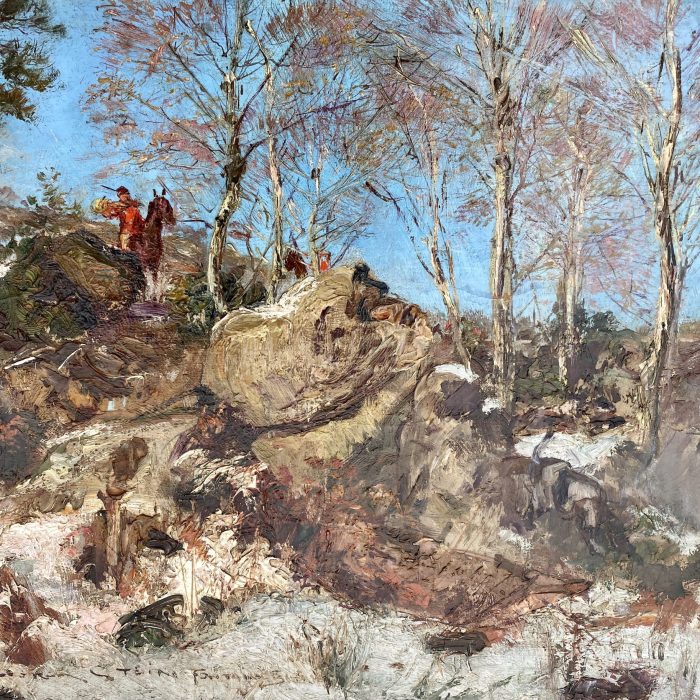
From an early age, Madyol painted the countryside around Woluwe, working alongside his father’s friend, the painter Jan Stobbaerts. This early experience in plein-air painting remained important throughout his career. At the beginning of the twentieth century, Madyol also shared a studio with the painter Ferdinand Schirren in Brussels. He later lived in Schaerbeek and developed an especially strong connection with the south of France, maintaining a studio in the old quarter of Nice. There, he became known for his luminous southern landscapes, often animated by characteristic local figures.
Madyol was closely involved in the artistic life of Brussels and was a co-founder of the artists’ circle Le Labeur in 1898, together with artists including Jan Stobbaerts. The group became an important part of the Brussels artistic scene at the turn of the century and was associated with the development of Brabant luminism and a renewed interest in direct observation and light.
Alongside his landscapes and genre subjects, Madyol established a considerable reputation as a portrait painter. He was commissioned to portray prominent Belgian figures, including Queen Elisabeth and several Belgian generals of the First World War. He also painted a portrait of the Nobel Prize-winning scientist Dr Jules Bordet in 1921, a work documented in the collections of the Institut Pasteur archives.
One of the most significant commissions of his career was the portrait of King Albert I, painted in 1927. The monumental portrait, now in the collection of the Brazilian Senate in Brasília, measures 253 × 200 cm. According to the Senate’s historical records, the painting was presented by the Belgian Parliament to the Brazilian Parliament on the occasion of King Albert I’s visit to Brazil. The work bears the signature Jacques Madyol / Bruxelles.
Madyol exhibited regularly during the first decades of the twentieth century. His exhibitions included the Exposition Triennale d’Anvers in 1901, exhibitions in Brussels in 1907, the Exposition Universelle et Internationale de Bruxelles in 1910, and later exhibitions with the Cercle Artistique et Littéraire de Bruxelles. His work is also documented in the 1914 Exposition Générale des Beaux-Arts in Brussels, where he exhibited Vieux Provençal.
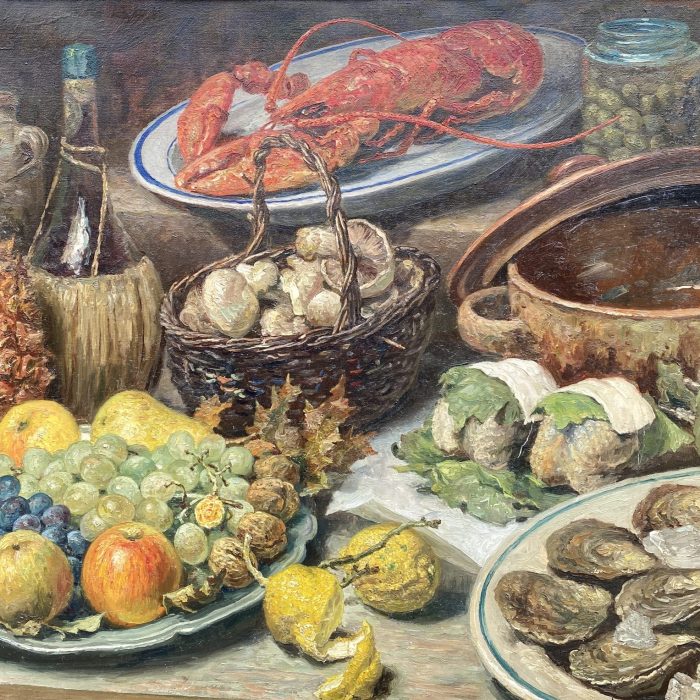
His artistic production reveals a particular sensitivity to light, atmosphere and the character of place. From the Belgian countryside and intimate figurative scenes to the brilliant Mediterranean landscapes around Nice, Madyol combined a fundamentally figurative approach with a luminous, freely observed manner. His still lifes likewise demonstrate his interest in colour, texture and the richness of everyday subjects.
Today, Madyol’s work is represented in institutional and private collections. His portraits are preserved in the collections of the Royal Museum of the Armed Forces and Military History in Brussels, while his portrait of King Albert I belongs to the Brazilian Senate collection. His work is also recorded in Belgian heritage collections, including the monumental 1927 portrait of Albert I held by the Municipality of Schaerbeek.
Selected literature:
W. G. Flippo, Lexicon of the Belgian Romantic Painters, Antwerp, 1981.
G. Pas, Biografisch Lexicon Plastische Kunst in België, Arto, 2000, p. 91.
Paul Piron, De Belgische Beeldende Kunstenaars uit de 19de en 20ste eeuw, Art in Belgium, p. 890.
Obras de Arte do Senado Federal, Brasília, Senado Federal.
Zeedijk – Het Zoute 731, 8300 Knokke
Belgium
+32 478 22 65 64
info@valentinasafarian.com
© Copyright 2023 Valentina Safarian | Website by BEAUX SITES