Bruges 1870 – 1937 Brussels
Belgian Painter
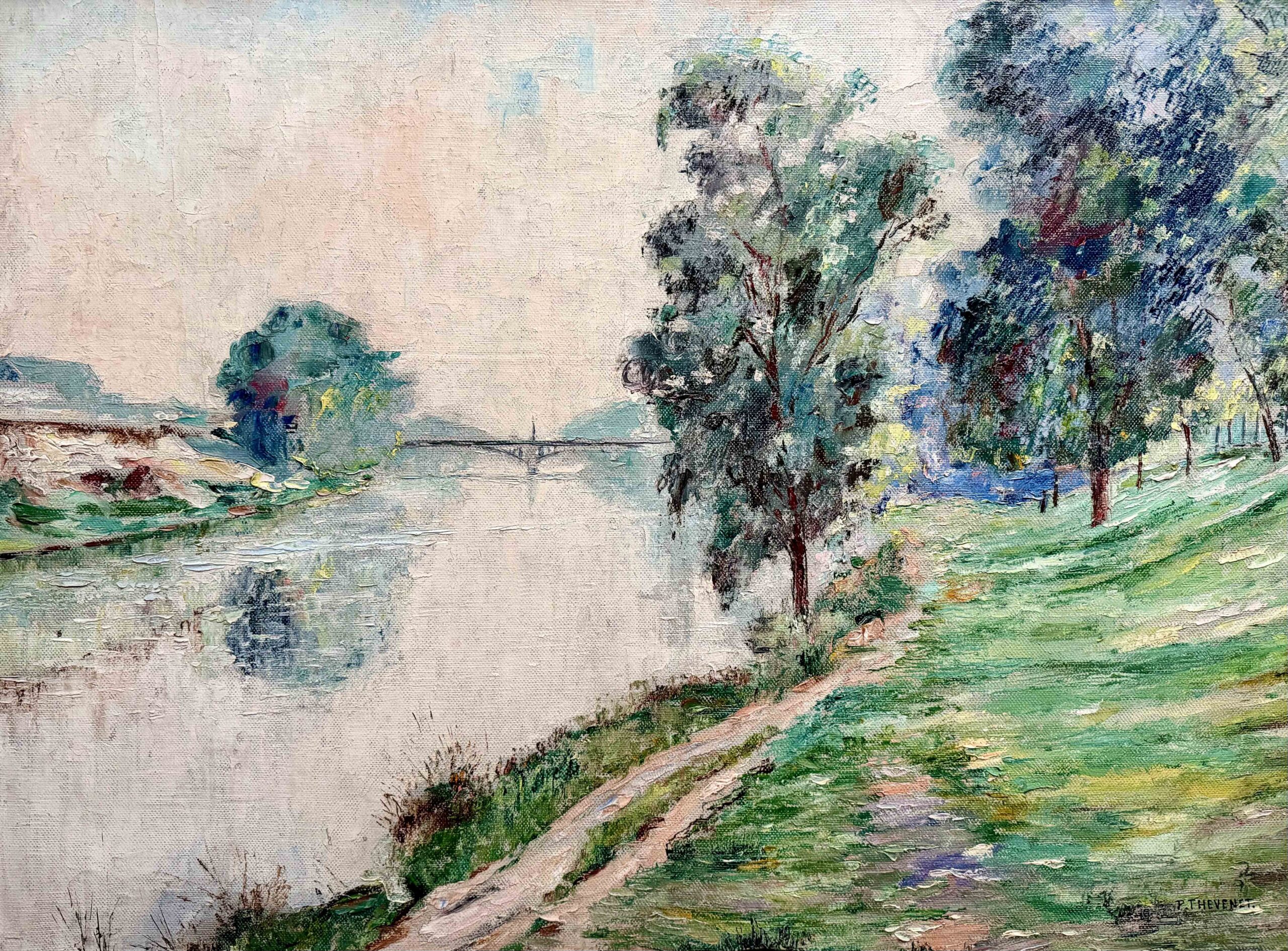
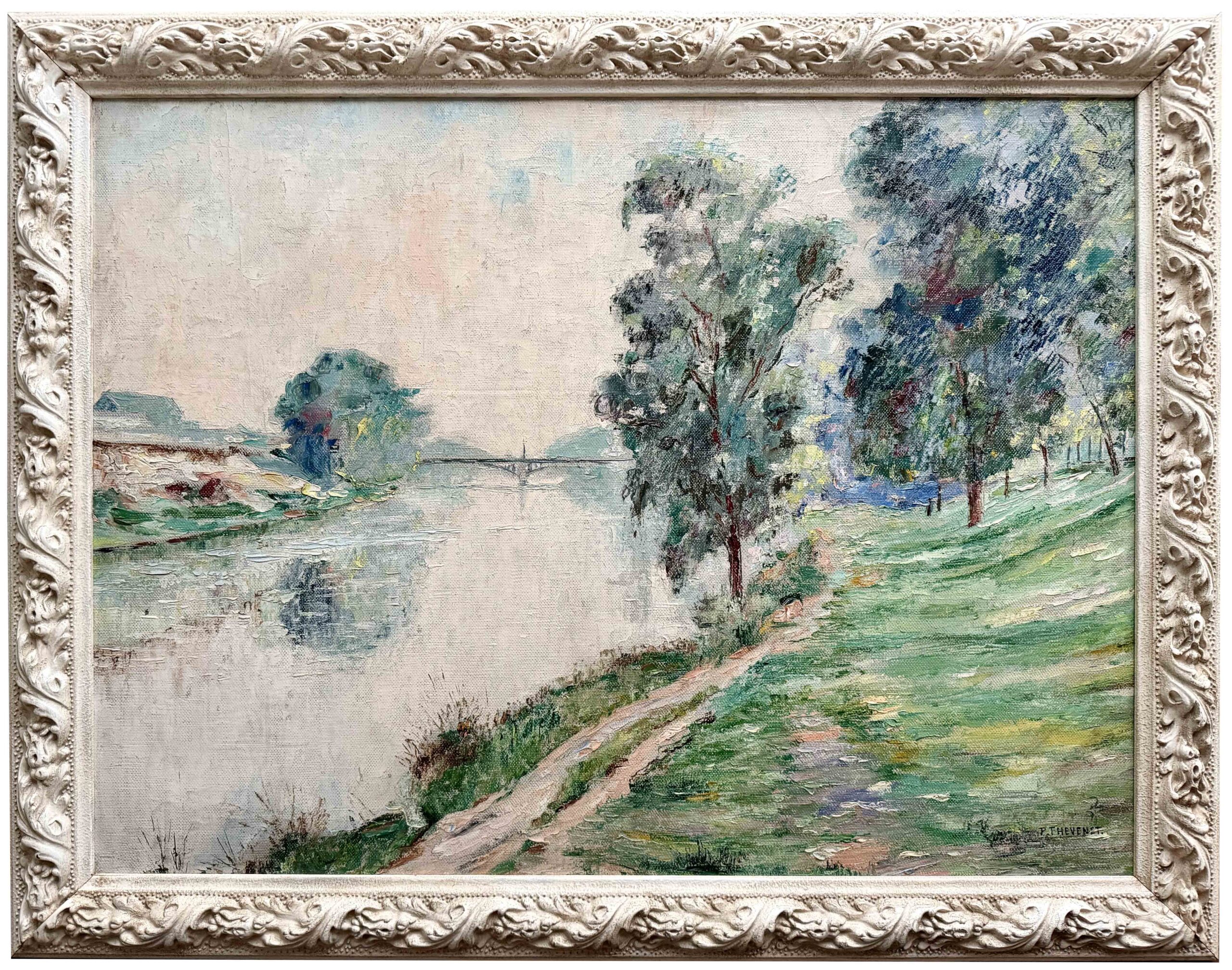
La Seine à Paris
Pierre Thevenet was born in Bruges on March 1, 1870. He was a Dutch-Belgian post-impressionist painter, born into a family of artists alongside his brother Louis Thevenet, active in Fauvist circles, and his sister Cécile Thevenet, a celebrated opera singer at the Opéra-Comique in Paris. At a young age, he moved with his parents to Brussels, where his father, Alphonse Thevenet, served as organist at the Coudenberg Church.
From his first marriage, Pierre Thevenet had two sons. Around 1910, he met the actress and recitation artist Madeleine Renaud. Due to a difficult divorce, the couple lived apart for an extended period. Madeleine worked in Paris with the theatre company La Compagnie du Vieux-Colombier under theatre and film icon Louis Jouvet, performing spoken and choral parts in Greek tragedies. She also maintained close contacts with playwright Paul Claudel and composer Darius Milhaud. At the end of 1922, Pierre spent some time in Venice, and in 1924 their daughter Françoise was born.
As a landscape painter, Thevenet’s career developed in three main phases. His earliest works were created in Brussels and the Zenne Valley southwest of the city. Influenced by the work of his partner and sister in Paris, he spent increasing periods in the French capital between 1920 and 1930, earning the description “le plus parisien des peintres de chez nous.” During this period, he frequently painted the Seine as it meandered through Paris and its surrounding neighborhoods.
From 1930 onward, Thevenet resided mainly in Belgium again, in the cottage Madeleine had purchased by Lake Genval. He was part of an artistic circle in Anseremme (near Dinant), where he painted the Meuse River and its surroundings. Pierre Thevenet died on March 27, 1937, after a three-week illness, from heart failure.
In the 1930s, his work was highly appreciated in Brussels, with a retrospective at the Galerie de la Toison d’Or (1934), a sales exhibition at the Palais des Beaux-Arts (1935), and later retrospectives at the Palais des Beaux-Arts and La Maison Communale of Anseremme (1937). His paintings were sought after by international collectors and art enthusiasts.
Thevenet’s depictions of Paris and its surroundings often portrayed the densely built-up city center, more urbanized than he portrayed on canvas. He frequently painted in the suburbs, including Meudon, Sèvres, Bellevue, Longchamp, Billancourt, Saint-Cloud, and Issy, many of which were incorporated into Paris shortly after 1900 during urban renovations led by Prefect Georges Haussmann.
The works of Pierre Thevenet can be found in public collections and museums, including the Royal Museums of Fine Arts of Belgium (Brussels), the Musée d’Art Moderne de la Ville de Paris, the Musée des Beaux-Arts de Liège, and the Groeningemuseum in Bruges.
Literature
René Ducoffre, Palette et Paroles (1998)
Wim & Greet Pas, Biographical Lexicon of Plastic Arts in Belgium (2000)
Serge Goyens de Heusch, Impressionism and Fauvism in Belgium (1988)