London 1915 – 2013 Brussels
British – Belgian Painter
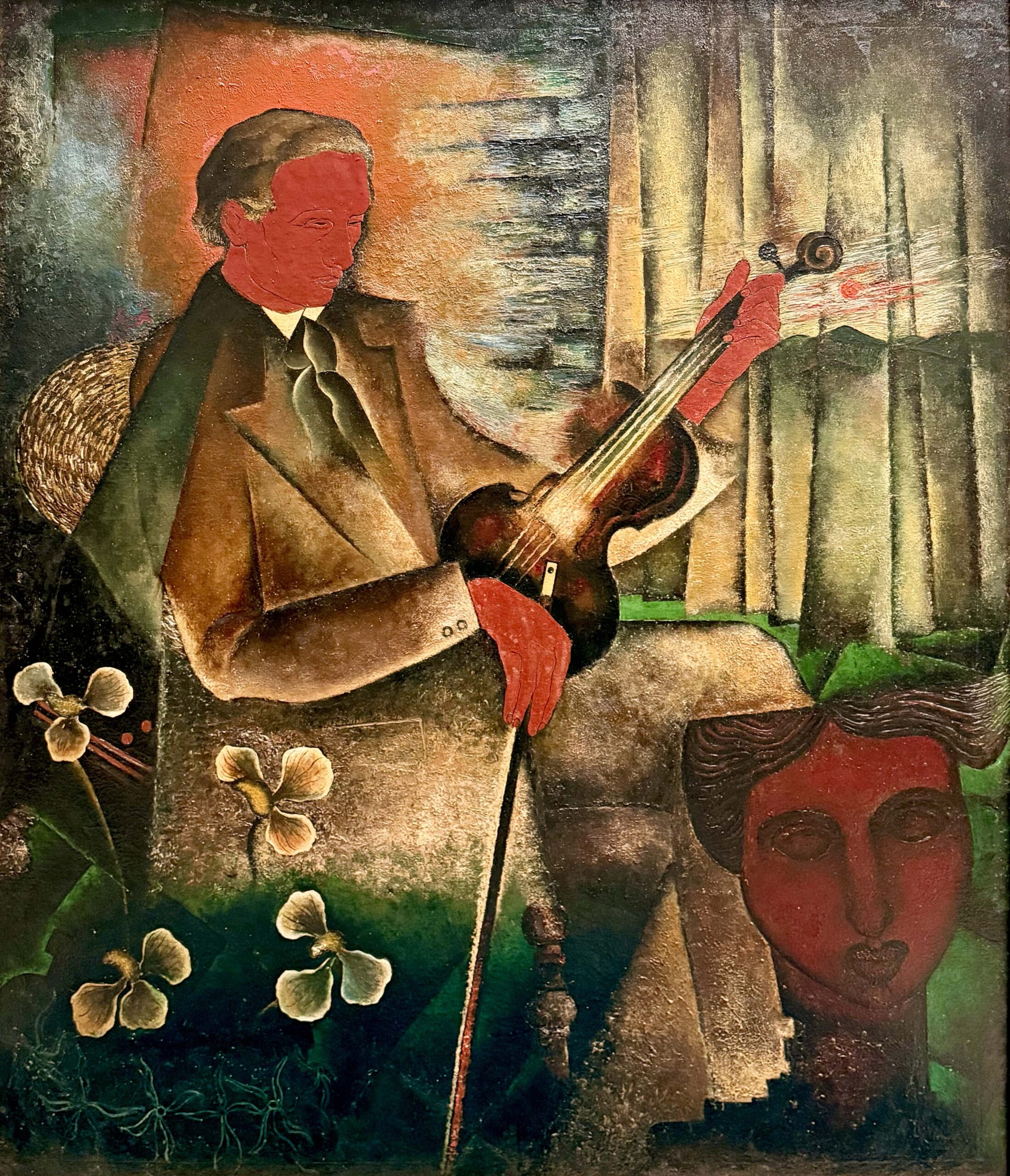
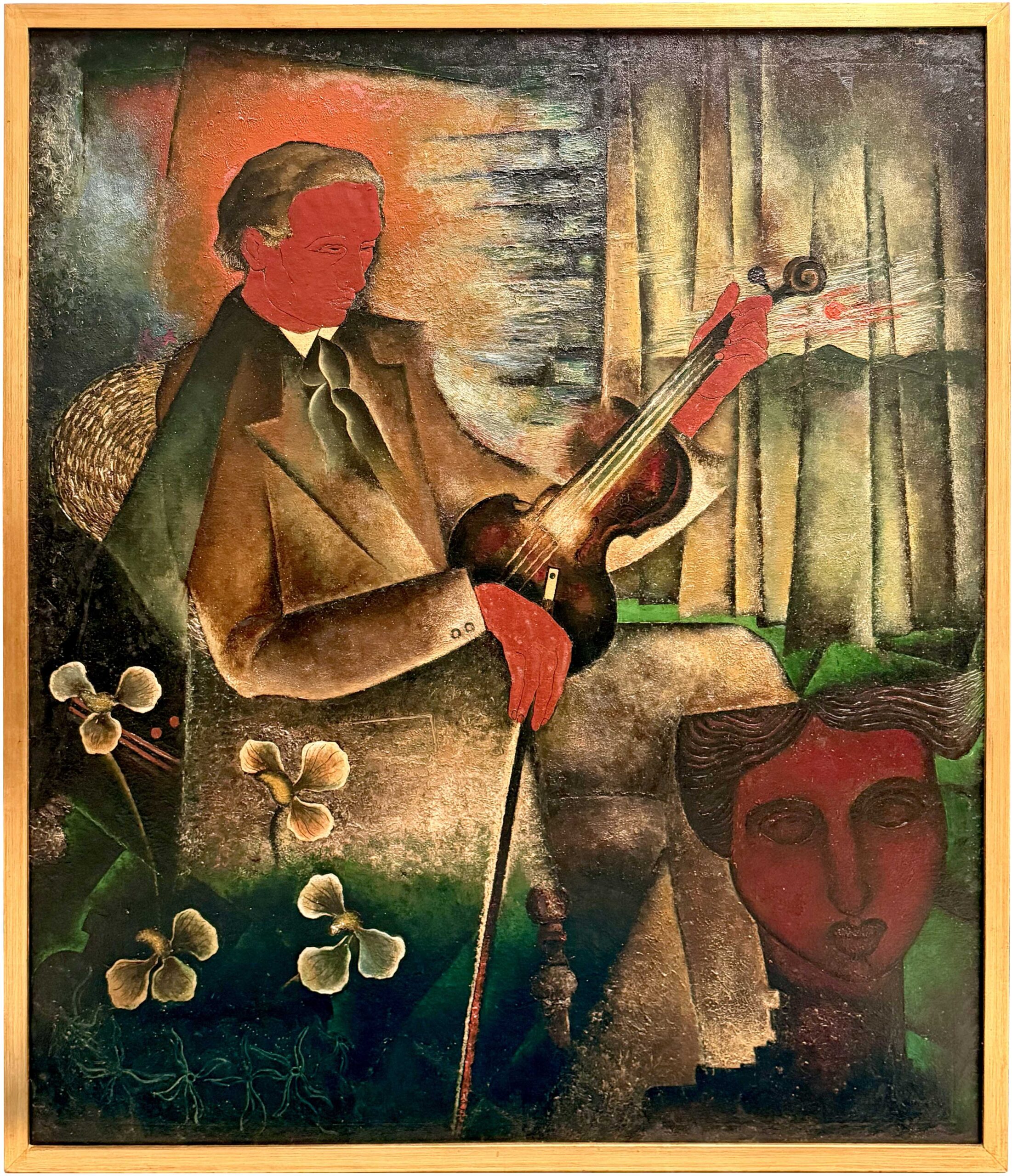
The Red Violinist
Marc Mendelson was born in London in 1915 to an English mother and a Flemish father, originally bearing the family name Mendelsohn. After the end of the First World War, the family returned to Antwerp in 1922, where he grew up and began his artistic education.
He first studied at the Antwerp Academy and subsequently at the Higher Institute of Fine Arts in Antwerp, where he was trained by Gustave van de Woestyne and Isidore Opsomer. Their influence is clearly visible in his early figurative work, which reflects the introspective and poetic tradition of Belgian animism.
His first artistic period spans the early nineteen thirties up to the Second World War. During these years, he became active in the Antwerp art scene and formed close friendships with artists such as Jan Cox and Rudolf Meerbergen. In 1943, together with them, he organised his first major exhibition at Galerie Lamorinière in Antwerp, followed by an invitation to exhibit at the Palais des Beaux Arts in Brussels in 1944.
During the Second World War, however, Mendelson’s work was labelled “degenerate” by the occupying authorities. Suspected of being a British Jew and associated with the Allied enemy, he was arrested by the Gestapo and imprisoned for approximately six months in Antwerp, Brussels, and Mechelen.
After the war, he settled permanently in Brussels. In 1945, he became a founding member of La Jeune Peinture Belge, alongside artists such as Gaston Bertrand, Anne Bonnet, Jo Delahaut, Louis Van Lint, and others. Supported by the patron René Lust, the group played a decisive role in the renewal of Belgian post war painting, promoting a modern figurative language characterised by clear structure and vibrant colour. The movement dissolved in 1948 following Lust’s sudden death.
From that point onward, Mendelson pursued an independent artistic path. He taught for more than thirty years at La Cambre in Brussels, training generations of artists. In his own practice, he gradually moved from figuration toward a more material and non figurative language, incorporating sand, plaster, and incised markings reminiscent of hieroglyphs. Throughout his life, he resisted being classified as an abstract artist, preferring the term non figurative.
From the nineteen sixties onward, he partially returned to a more personal form of neo figuration, while also working extensively in watercolour, printmaking, and sculpture. His work was exhibited internationally, including at the Venice Biennale in 1948, the São Paulo Biennale in 1951 and 1953, and the Carnegie International in Pittsburgh. In 1965, he was elected a member of the Royal Academy of Belgium.
He also executed important public commissions, notably the mural Happy Metro to You in 1974 in the Park metro station in Brussels.
Marc Mendelson died in Uccle in Brussels in 2012 at the age of 97. Today, he is regarded as a key figure of Belgian modernism, whose oeuvre reflects the evolution of post war European art while maintaining a strongly personal visual language.
The painting The Red Violinist also known under the early subtitle The Grandson of Peter Benoit dates from 1933 and is one of Marc Mendelson’s earliest known works. The artist was only eighteen years old at the time and still a student at the Antwerp Academy, before entering the Higher Institute of Fine Arts.
The work is a rare early testimony of his artistic development and clearly reflects the visual language of the interwar period. It combines influences of Art Deco with a strong pictorial freedom. Vivid colours, particularly the striking red of the figure’s head and hands, are set against a dynamic structure of vertical and horizontal brushstrokes.
The composition depicts a violinist in an interior setting with an armchair, floral motifs, and decorative elements that highlight the playful and ornamental sensibility of the period. At the same time, there is an early and remarkable sensitivity to surface and texture. The thick impasto anticipates Mendelson’s later interest in material painting, which would evolve into his form of matiérisme.
The painting is signed and dated in the upper right corner in red-brown paint, a rare feature for this early stage of his career. Even more unusually, it is signed Mendelsohn. This name was later changed to Mendelson after the family settled in an English speaking context following the First World War.
The Violinist thus stands not only as an exceptional early work within Mendelson’s oeuvre, but also as a document of an artist in formation, already revealing the tensions between figuration, expression, and material experimentation that would define his later career.
- Willem M Roggeman Marc Mendelson De Post 1980
- Willem M Roggeman Conversation with Marc Mendelson De Vlaamse Gids 1984
- Michel Draguet and Serge Goyens de Heusch Young Belgian Painting 1945 to 1948 1992