Schrobenhausen 1836 – 1904 Munich
German Painter
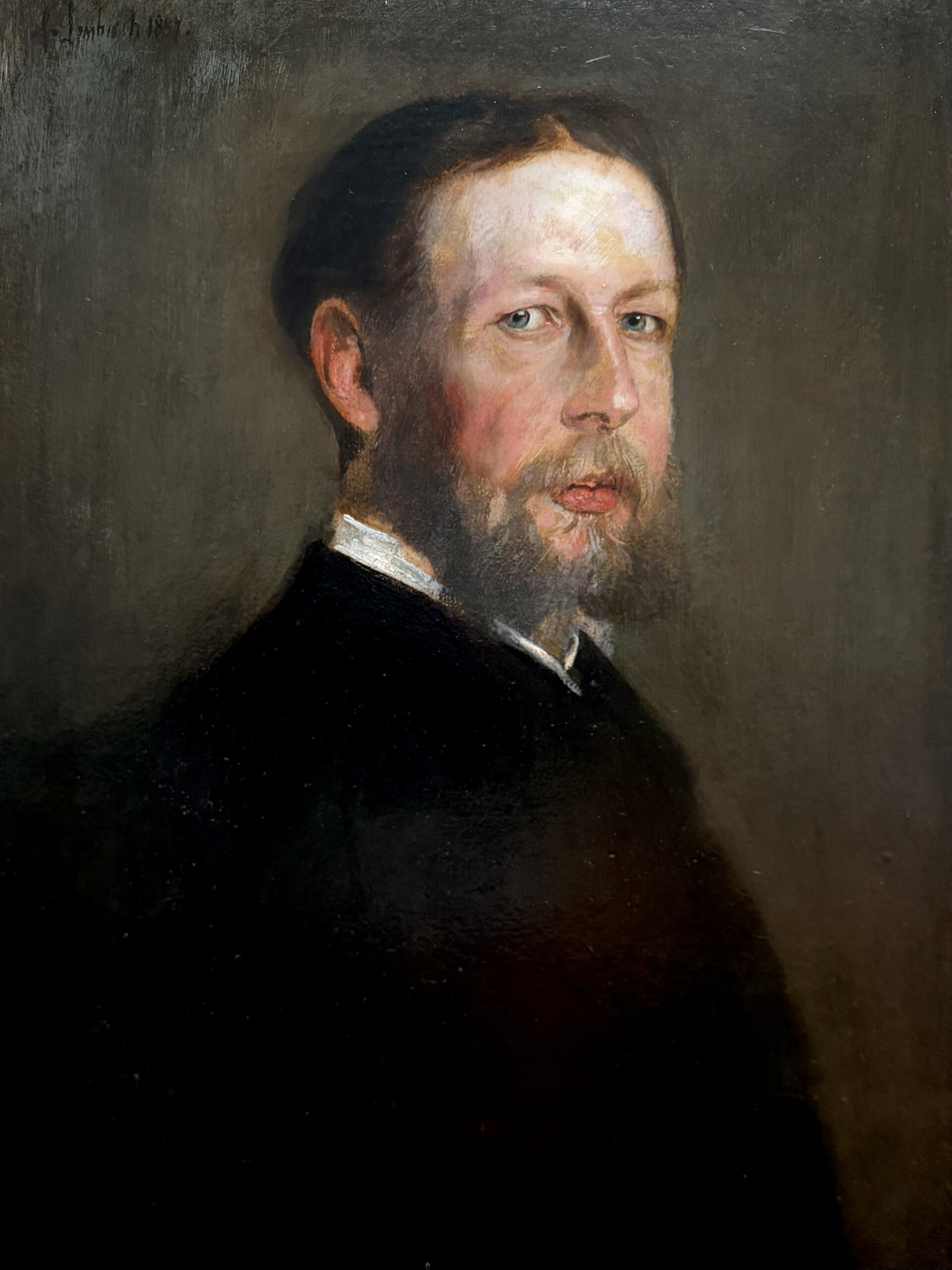
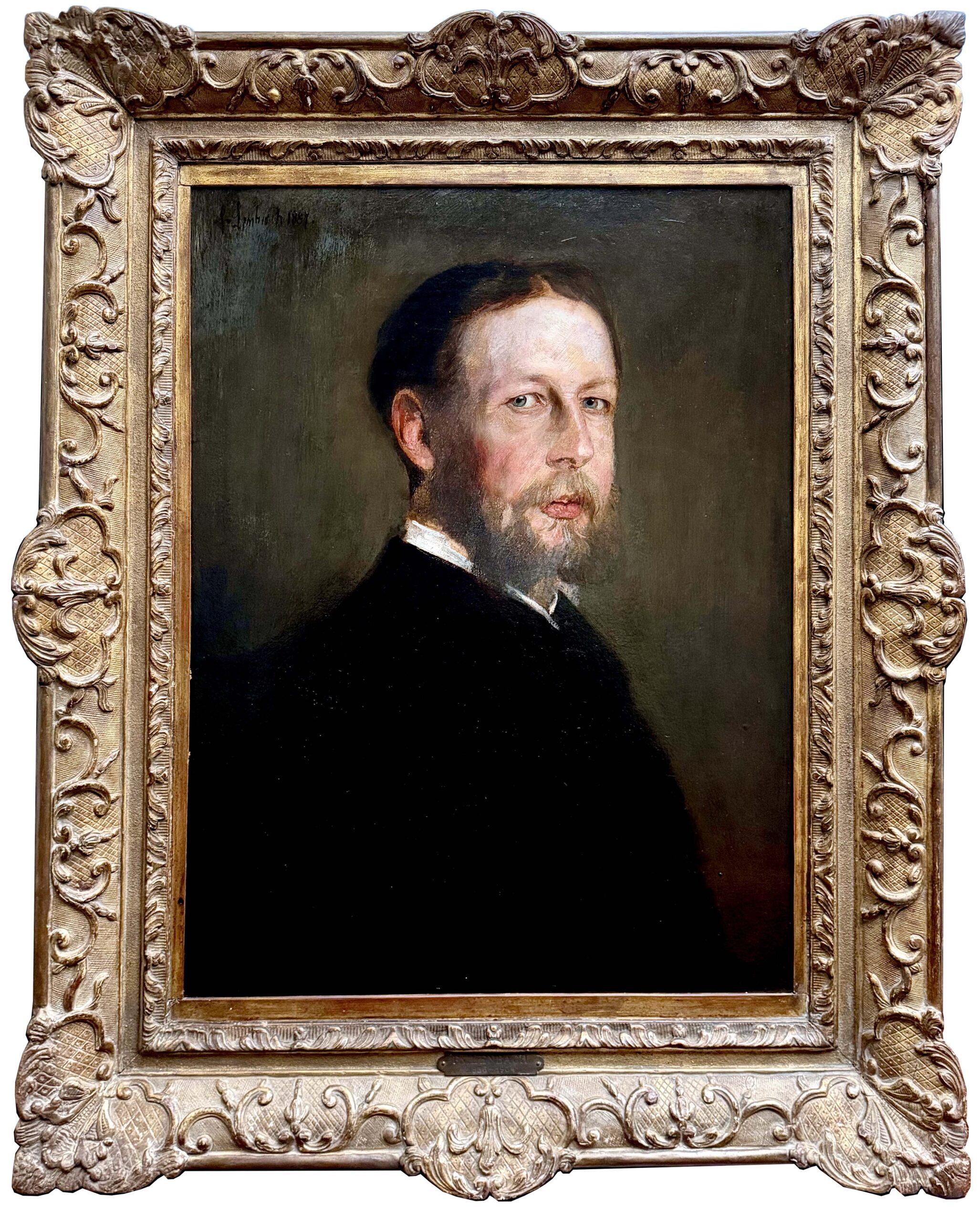
Self-portrait of Franz Seraph Lenbach
Franz Seraph Lenbach, later ennobled as Ritter von Lenbach, was born on 13 December 1836 in Schrobenhausen. He became one of the most celebrated portrait painters of late 19th-century Germany. Renowned for his commanding likenesses of political leaders, aristocrats, industrialists, and cultural figures, he earned the epithet “Malerfürst” — the “Painter Prince” — reflecting both his artistic stature and his prominent social position.
Lenbach was the son of a master mason whose family originated in South Tyrol, where the family name was originally spelled “Lempach.” After completing primary schooling in Landsberg in 1848 and attending business school in Landshut, he apprenticed in Munich with the sculptor Anselm Sickinger from 1851 to 1852. Following his father’s death, he briefly returned home to assist with the family business before resuming his artistic ambitions.
He continued his studies in Augsburg and, in 1854, entered the Academy of Fine Arts, Munich, later taking private lessons with Hermann Anschütz. His decisive artistic formation came under the influential history painter Karl von Piloty. In 1858, Lenbach exhibited at the Munich Glaspalast and received a travel scholarship that enabled him to accompany Piloty to Rome. Travels to Italy, Paris, and Brussels broadened his artistic outlook and led to his early portrait commissions.
Lenbach was appointed professor at the newly founded Weimar Saxon Grand Ducal Art School, where he became known for taking students on plein-air painting excursions. After two years, he returned to Italy, supported by Baron Adolf Friedrich von Schack, whose patronage allowed him to study Old Masters and refine his technique.
Returning to Munich in 1866, Lenbach’s reputation grew steadily. He won a gold medal at the 1867 Exposition Universelle and traveled to Spain with his pupil Ernst Friedrich von Liphart to copy Spanish masters. His breakthrough came in 1869 with another gold medal at the Glaspalast, cementing his status as one of Europe’s leading portraitists. After 1870, he cultivated an important clientele in Vienna, further expanding his international prominence.
Between 1875 and 1876, Lenbach traveled to Egypt with Hans Makart and others, an experience that subtly influenced his palette and atmospheric treatment. In 1882, he was awarded the Bavarian Order of Merit of the Crown, which conferred nobility and the title “von Lenbach.” The following year he resided in Rome at the Palazzo Borghese, painting distinguished sitters including Clara Schumann. In 1885, he was commissioned to portray Pope Leo XIII, using photographic aids when the pontiff was unable to sit extensively, a practice Lenbach increasingly adopted.
By the late 1880s, Lenbach had built a grand villa in Munich, today known as the Lenbachhaus Museum. His portraits of statesmen such as Otto von Bismarck and William Ewart Gladstone became iconic images of political authority. His works entered major public collections, including the National Galleries of Scotland, the Palace of Westminster, and museums across Germany and the United States.
In the 1890s, Lenbach increasingly relied on photographic sources and maintained a prolific output, though not without controversy. In 1895, a scandal arose when assistants completed works that were subsequently attributed to him. His personal life was equally eventful; after divorcing Countess Magdalena Moltke, he married Charlotte von Hornstein, daughter of composer Robert von Hornstein.
Lenbach declined to join the Munich Secession and remained critical of emerging modernist movements. Around 1900, he produced commercial designs, including trading cards for the Stollwerck chocolate company of Cologne. In 1902, he was made an honorary Knight of the Légion d’Honneur. That same year, he suffered a stroke from which he never fully recovered. He died on 6 May 1904 in Munich and was buried at the Westfriedhof, his funeral attended by numerous prominent figures.
In the 20th century, Lenbach’s works were highly valued within National Socialist circles and were also subject to confiscation and looting from Jewish collectors, a legacy that continues to inform provenance research.
Today, his portraits remain significant documents of the political and cultural elite of his era, exemplifying the grandeur and authority of late 19th-century European portraiture.