Leipzig 1895 – 1977 Munich
German Painter

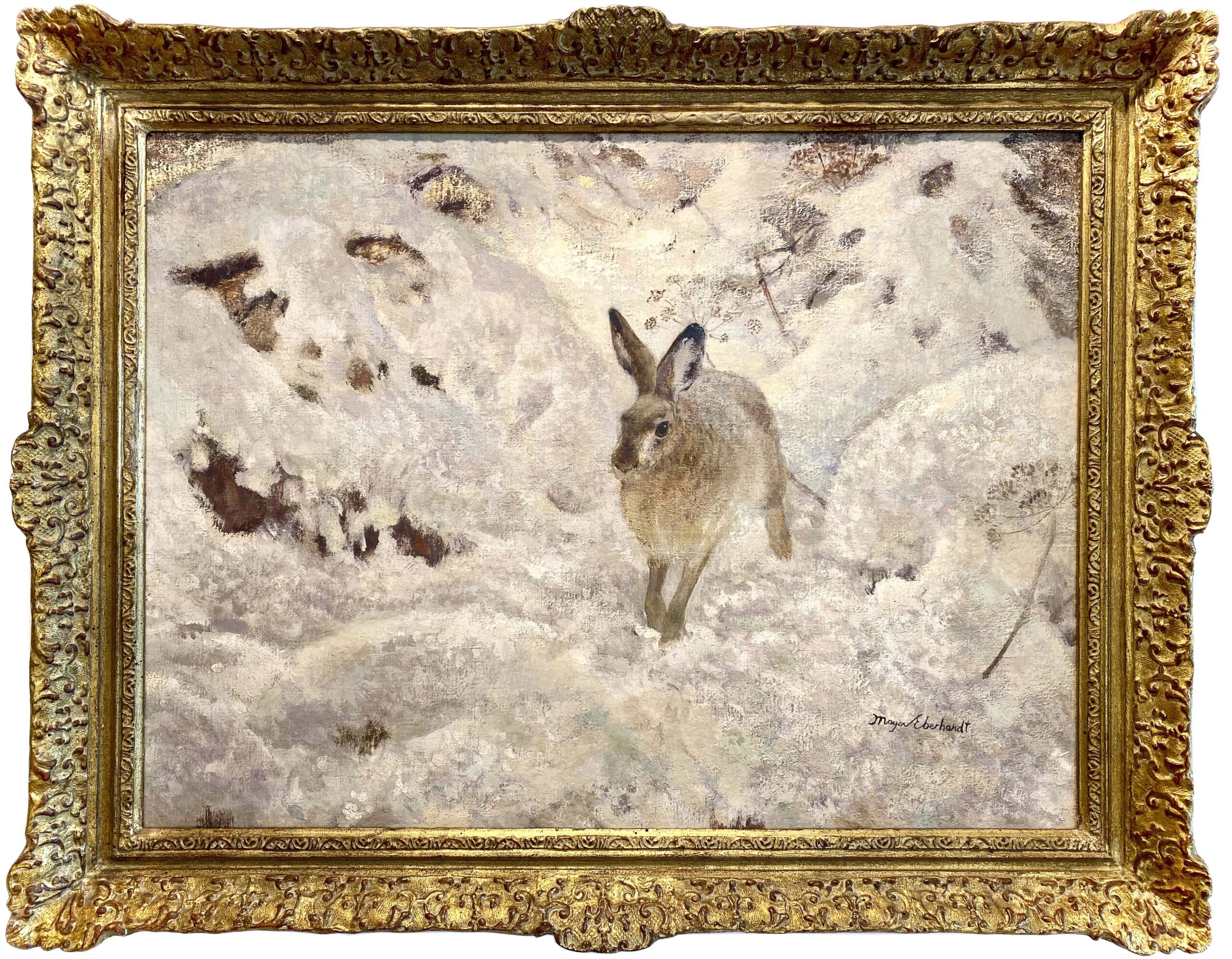
Hare in the Snow
Kurt (also Curt) Meyer-Eberhardt was born on April 10, 1895, in Leipzig. Born Kurt Ernst Meyer, he adopted the artist name Meyer-Eberhardt in 1916, incorporating his mother’s maiden name. He was a German painter, graphic artist, and illustrator, best known for his skillful animal depictions, often imbued with emotion or humor. His cold-needle etchings, first published in 1916 by the Hanfstaengl Verlag, remained popular well beyond his lifetime.
Meyer-Eberhardt’s early work up to the early 1920s reflects various art movements of the late 19th and early 20th centuries. His later paintings and commissioned graphic works, particularly landscapes, animal portraits, and still lifes, are regarded as a contribution to the tradition of the realistic Munich School.
He grew up in Erfurt from 1899 and studied from 1912 to 1917 at the Grand-Ducal Saxon School of Fine Arts in Weimar under Max Thedy, Theodor Hagen, and Walther Klemm. He became Klemm’s master student in 1916. During his studies, he experimented with portraiture, interiors, animal representation, impressionist landscapes, and etching techniques. From 1915, he began working independently in Munich, interrupted by brief military service.
In the winter semester of 1919/1920, Meyer-Eberhardt returned to Weimar to attend the newly founded Bauhaus, where he studied figure and portrait classes with Lyonel Feininger and possibly Johannes Itten’s preliminary course. On July 1, 1920, he married Bauhaus student Luise Gertrud Neumann, who died in 1965, and permanently settled in Munich.
During the war and early postwar years between 1915 and 1920, he produced cold-needle etchings depicting marginalized groups, such as unemployed people, brothels, and circus scenes. These works express both melancholic and satirical tones. Together with studies and a painting from his Bauhaus period, they reflect his engagement with Expressionist and Cubist forms into the early 1920s. Afterwards, he returned to a more impressionistic and naturalistic style.
From the mid-1920s onward, his career was shaped by a dual approach. Commercial work, including animal etchings and hunting scenes, provided a livelihood, while independent creations in a form of inner emigration reflected his personal artistic vision. His watercolors and pastels of circus poodles from the late 1920s and early 1930s and the post-1945 Memento mori series of abandoned war horses stand out as sensitive, socially aware contributions to animal portraiture, in which human figures largely disappear from his work.
Another lifelong focus of his work included interiors, still lifes, and landscapes, particularly of the Munich area and the Mediterranean, showing hints of Cézanne’s influence. Meyer-Eberhardt avoided both military service and participation in the Nazi art scene. His artistic friendships included correspondence with Adolf Brütt and Oskar Coester. From 1972, he received a lifelong honorary pension from the City of Munich. His studio was located at Gedonstraße 6 in Munich-Schwabing.
Meyer-Eberhardt’s works are held in prominent public collections, including the Lenbachhaus Municipal Gallery in Munich, the Bavarian State Graphic Collection in Munich, and the Graphic and Painting Collections of the Klassik Stiftung Weimar. He died on July 25, 1977, in Munich.
Many works remain in private hands, including holdings at the Kunst- und Kulturhof Fischen, Siegfried Kuhnke, and at the Blanc Art Publishing and Copperplate Printing House in Munich, where original plates and prints by his last printer, Franz Duchatsch, are preserved. His estate is cared for by Christine Wacker.