Antheit 1897 – 1994 Veurne
Belgian Painter
+32 478 22 65 64 | info@valentinasafarian.com

Antheit 1897 – 1994 Veurne
Belgian Painter
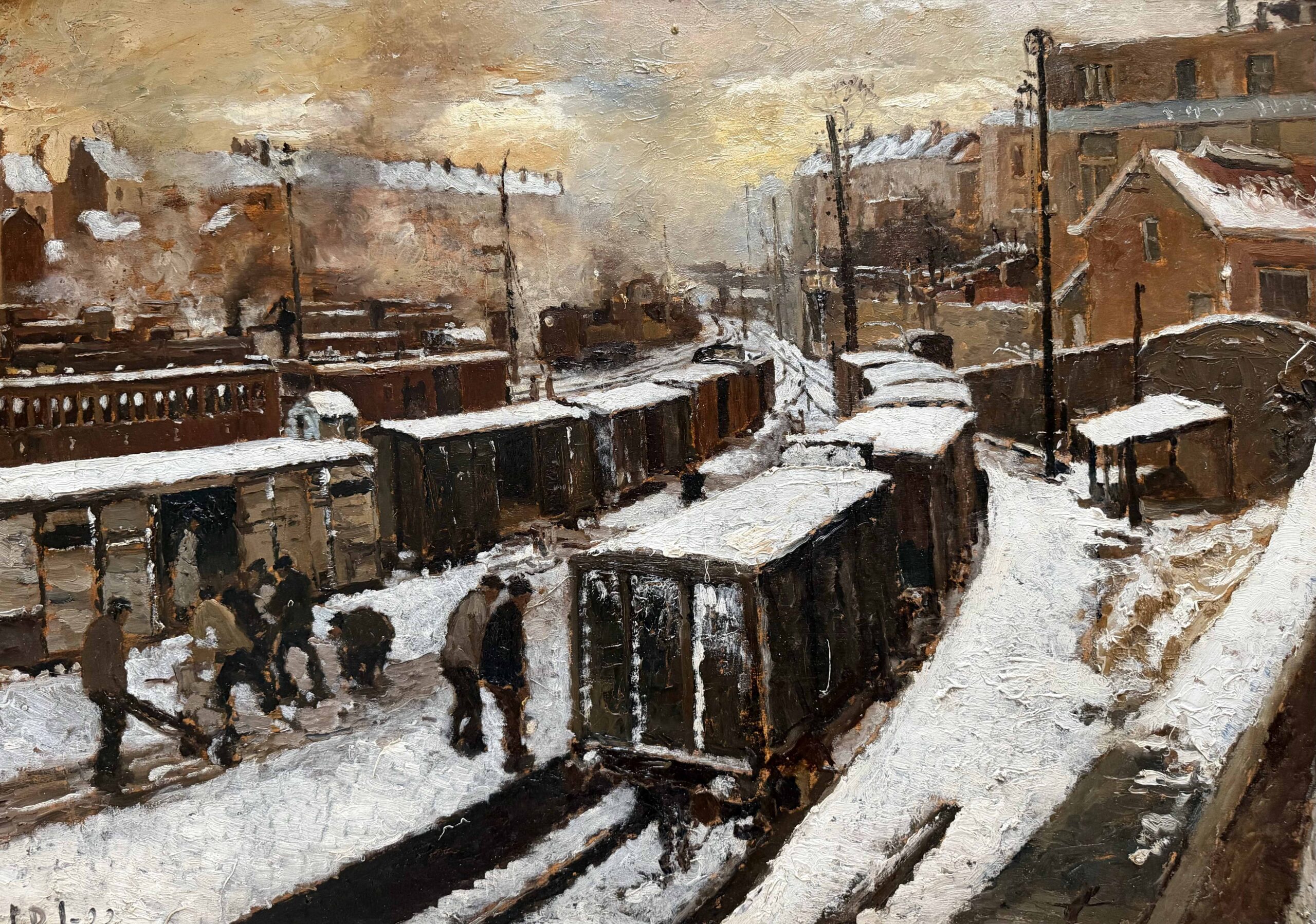
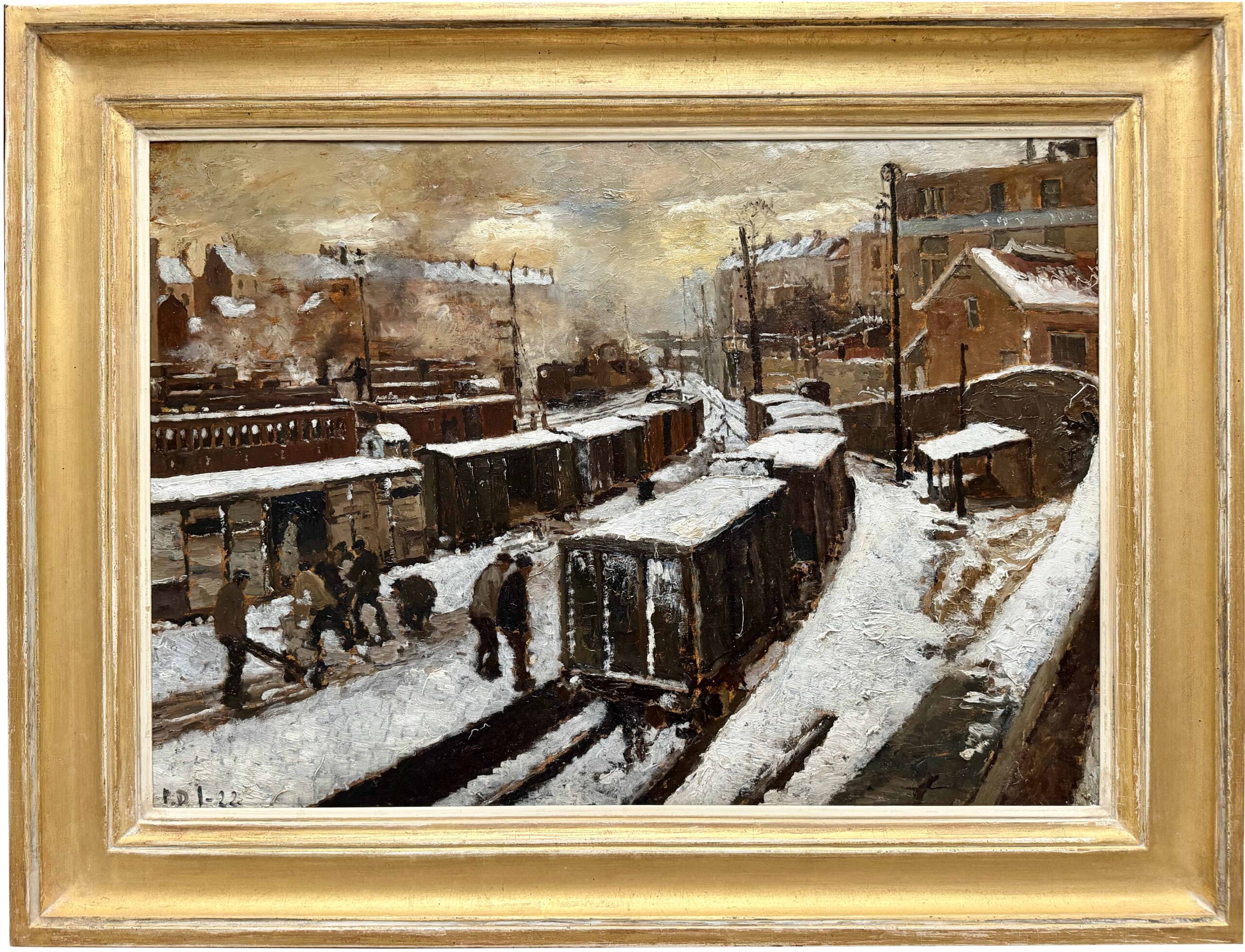
Note: Luxembourg Station Under Snow – Brussels, 1922
Painted in 1922, Gare du Luxembourg sous la neige belongs to Paul Delvaux’s rare and highly important early railway paintings, created long before the dreamlike imagery for which he became internationally celebrated. Combining remarkable technical precision with an atmosphere of silence and quiet melancholy, the work reveals the artist’s lifelong fascination with railway stations as places of transition, memory and contemplation. Today, these early railway scenes are recognised as key works in the development of Delvaux’s unique artistic vision and rank among the most sought-after paintings from his formative years.
Exhibitions:
Literature:
Comparative Works:
Gare du Luxembourg sous la neige (1922) by Paul Delvaux depicts the former Brussels-Luxembourg railway station, a historic station in Brussels’ Leopold Quarter that no longer exists in its original form. The station held particular significance for Delvaux, whose lifelong fascination with railways, stations, and locomotives became a recurring theme throughout his oeuvre.
Some interesting facts:
Paul Delvaux Museum
The Paul Delvaux Museum (Musée Paul Delvaux) in Saint-Idesbald, Belgium, was established in 1982 by the Foundation Paul Delvaux. It houses the world’s largest collection of works by Paul Delvaux (1897–1994), including paintings, drawings, personal objects, and archival material, making it the leading institution dedicated to preserving and celebrating the artist’s life and legacy.
Note: Paul Delvaux’s railway paintings rank among the most remarkable and historically significant works of his early career. Painted in 1922, Gare du Luxembourg sous la neige belongs to a rare group of compositions executed before the artist embraced the dreamlike iconography that would establish his international reputation. These early railway scenes reveal a young painter whose fascination with modernity, architecture and perspective already anticipated the metaphysical atmosphere of his mature masterpieces.
Far from being a simple depiction of Brussels’ Luxembourg Station, the painting transforms an industrial landscape into a meditation on silence, memory and transition. Snow softens the geometry of the station, muting its activity and enveloping locomotives, freight wagons and railway tracks in an almost timeless stillness. The monumental scale of the railway infrastructure contrasts with the diminutive figures of the railway workers, whose discreet presence lends the composition both authenticity and humanity.
Delvaux observed the railway world directly and with extraordinary precision. During the early 1920s he regularly sketched railway yards, locomotives, freight wagons and maintenance crews, often working sur le motif. His remarkable attention to technical detail allows railway historians today to identify individual locomotive classes and wagon types represented in his paintings. Yet this documentary accuracy is always subordinated to a poetic vision. Unlike the social realism of the late nineteenth century, exemplified in Belgium by Constantin Meunier, Delvaux had no intention of depicting industrial labour as social commentary. His interest lay instead in rhythm, atmosphere and contemplation.
For Delvaux, the railway station became a symbolic place: a threshold between departure and arrival, between memory and expectation. This concept of the station as an intermediate, almost theatrical space would remain central throughout his artistic imagination. The empty platforms, endless perspectives and carefully orchestrated architecture already evoke the metaphysical sensibility of Giorgio de Chirico, whose work Delvaux later acknowledged as inspiring “a profound and lasting sense of kinship.” The emotional resonance of this painting lies precisely in that subtle ambiguity, where reality quietly gives way to memory and imagination.
The significance of Gare du Luxembourg sous la neige extends beyond its historical subject. It marks a pivotal moment in the evolution of one of Belgium’s greatest twentieth-century artists. Within these carefully observed railway scenes one already perceives the essential vocabulary of Delvaux’s mature oeuvre: architectural monumentality, suspended time, enigmatic silence and an atmosphere of restrained melancholy. The painting therefore occupies an important place within the artist’s development, bridging the observational realism of his formative years with the poetic metaphysical world for which he would become internationally celebrated.
Rarely appearing on the market, Delvaux’s early railway paintings are increasingly recognised as key works in understanding the evolution of his artistic vision. Their historical importance, technical refinement and exceptional atmosphere make them among the most desirable works from the artist’s formative period.
P a u l D e l v a u x M u s e u m
The Paul Delvaux Museum (Musée Paul Delvaux), located in Saint-Idesbald (Koksijde), Belgium, is dedicated to the life and artistic legacy of the renowned Belgian painter Paul Delvaux (1897–1994). Established in 1982 by the Foundation Paul Delvaux, it houses the world’s largest collection of the artist’s works, making it the principal institution devoted to the study and preservation of his oeuvre.
The museum was founded in recognition of Delvaux’s close personal connection with Saint-Idesbald, where he built his house and studio in 1951 in the style of a traditional Flemish fisherman’s cottage. A key figure in the museum’s creation was Delvaux’s nephew, Charles Van Deun, who acquired the former Het Vlierhof hotel on behalf of the Foundation and oversaw its transformation into a museum. The museum officially opened on 26 June 1982, attended by Paul Delvaux and his wife, Tam.
Following the artist’s death in 1994, the museum became the focal point for public tributes, welcoming more than 2,000 visitors who came to pay their respects. Delvaux and his wife also bequeathed a significant number of artworks and personal possessions to the museum, substantially enriching its permanent collection.
Originally conceived as an intimate museum reflecting Delvaux’s modest and reserved personality, it has expanded considerably over the years. In 1996, an underground extension was added, providing additional exhibition space for paintings, drawings, photographs, documents, manuscripts, and correspondence. After a comprehensive renovation and redesign, the museum reopened in 2016 with approximately 1,000 square metres of exhibition space.
Today, the Paul Delvaux Museum preserves and presents an exceptional collection spanning every period of the artist’s career. Alongside major paintings and drawings, visitors can discover personal objects, archival material, and memorabilia illustrating Delvaux’s lifelong fascination with railways, including historic tram and train models.
As the foremost centre dedicated to Paul Delvaux’s artistic heritage, the museum remains an essential destination for scholars, collectors, and admirers of one of Belgium’s most celebrated twentieth-century painters.
Biography: Paul Delvaux was born in Antheit, Belgium, in 1897 and became one of the most important Belgian painters of the twentieth century. Celebrated for his enigmatic dream worlds, classical architecture and poetic visions of solitude, he created an oeuvre that occupies a unique place between realism, symbolism and surrealism.
From an early age, Delvaux was fascinated by literature, architecture and the visual arts. He initially studied architecture before entering the Royal Academy of Fine Arts in Brussels, where he trained as a painter. During his formative years, he was influenced by the Belgian landscape tradition and by artists such as James Ensor and Constant Permeke. His early works reveal a strong interest in observation, perspective and the relationship between human figures and their environment.
During the 1920s, Delvaux developed a particular fascination for the world of railways. Stations, locomotives and railway workers became recurring subjects in his early paintings. These works, painted with remarkable precision and attention to detail, already reveal the qualities that would define his mature art: a sense of silence, mystery and suspended time. His railway scenes transformed everyday industrial environments into poetic spaces filled with nostalgia and contemplation.
A decisive turning point came in the 1930s, when Delvaux encountered the work of Giorgio de Chirico and the Surrealist movement. Inspired by De Chirico’s metaphysical landscapes, he began to explore a world where reality and imagination merge. His paintings became populated by mysterious female figures, empty streets, ancient architecture and dreamlike nocturnal settings. Unlike many surrealists, Delvaux did not seek the irrational through automatic expression; instead, he created meticulously composed scenes where every element contributes to a feeling of quiet mystery.
Throughout his long career, Delvaux remained deeply connected to themes of memory, desire, solitude and the passage of time. His fascination with classical architecture and the human figure resulted in an instantly recognisable visual language, marked by elegance, precision and poetic ambiguity.
Paul Delvaux received international recognition during his lifetime and represented Belgium at numerous exhibitions worldwide. His works are held in major museums and collections, including the Musées royaux des Beaux-Arts de Belgique, Musée d’Orsay and The Museum of Modern Art. In 1982, the Musée Paul Delvaux was founded to preserve and celebrate his artistic legacy.
Delvaux died in Veurne in 1994, leaving behind an exceptional body of work that continues to fascinate collectors, scholars and art lovers worldwide. His paintings remain timeless reflections on memory, mystery and the poetry hidden within everyday reality.
Zeedijk – Het Zoute 731, 8300 Knokke
Belgium
+32 478 22 65 64
info@valentinasafarian.com

© Copyright 2023 Valentina Safarian | Website by BEAUX SITES