Quaremonde 1620 – 1684 Antwerp
Flemish Painter
Draughtsman and Engraver
+32 478 22 65 64 | info@valentinasafarian.com

Quaremonde 1620 – 1684 Antwerp
Flemish Painter
Draughtsman and Engraver
Jan van den Hecke the Elder was a Flemish Baroque painter, draughtsman, printmaker and engraver, best known for his refined flower still lifes, landscapes and scenes of an Italianate character. Born in Kwaremont near Oudenaarde around 1620, he trained in Antwerp and became a master of the Guild of Saint Luke in 1642. He subsequently travelled to Italy, where he worked in Rome and enjoyed the patronage of Paolo Giordano II Orsini, Duke of Bracciano. He later spent time in Brussels before returning to Antwerp, where he settled permanently in 1659.
Van den Hecke’s flower paintings were particularly sought after. During his period in Brussels, he is believed to have produced flower still lifes for Archduke Leopold Wilhelm of Austria, governor of the Spanish Netherlands and one of the great collectors of seventeenth-century European art. Several of Van den Hecke’s flower paintings entered the Archduke’s celebrated collection, which later formed an important part of the picture collection of the Kunsthistorisches Museum in Vienna.
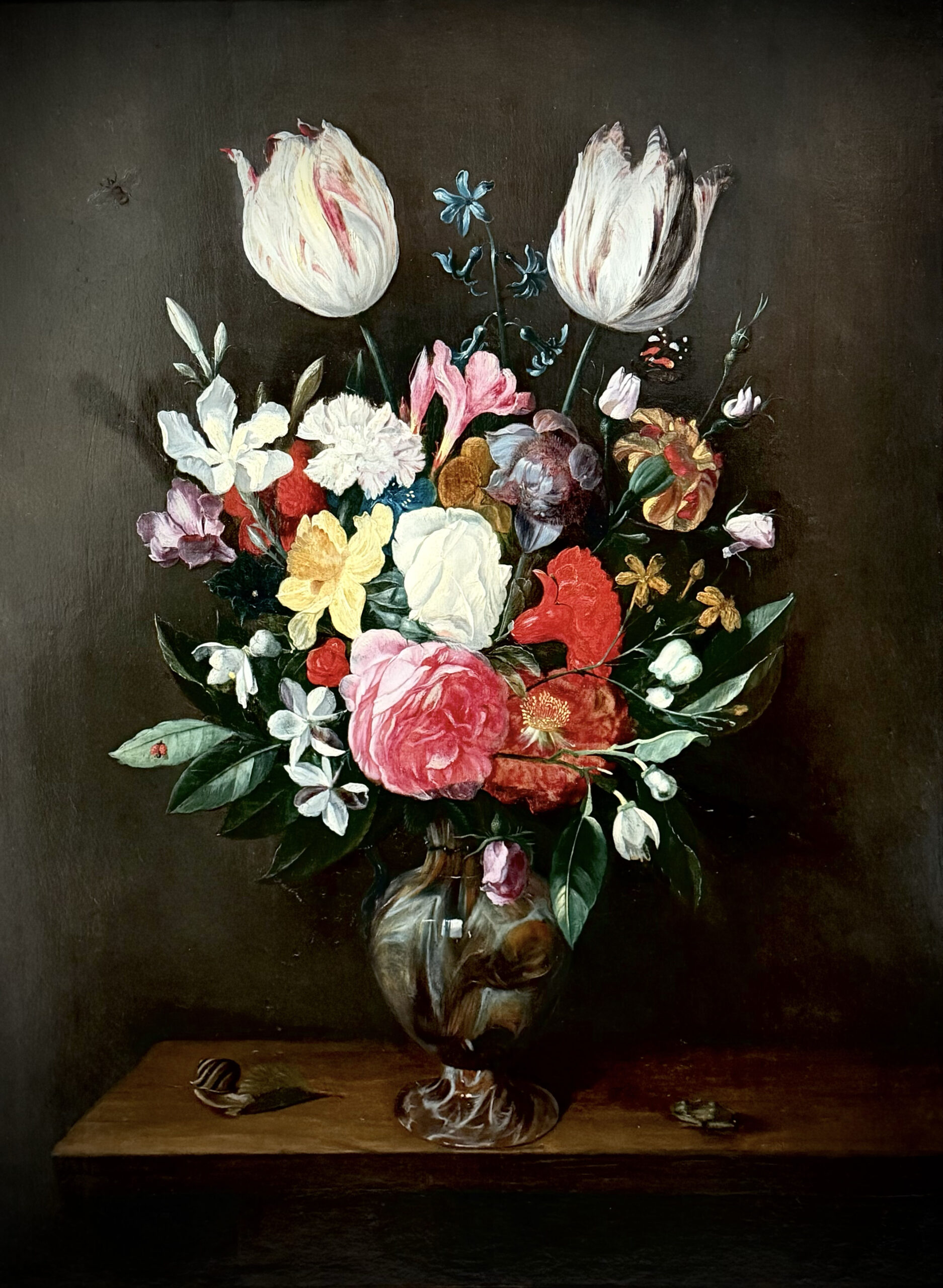
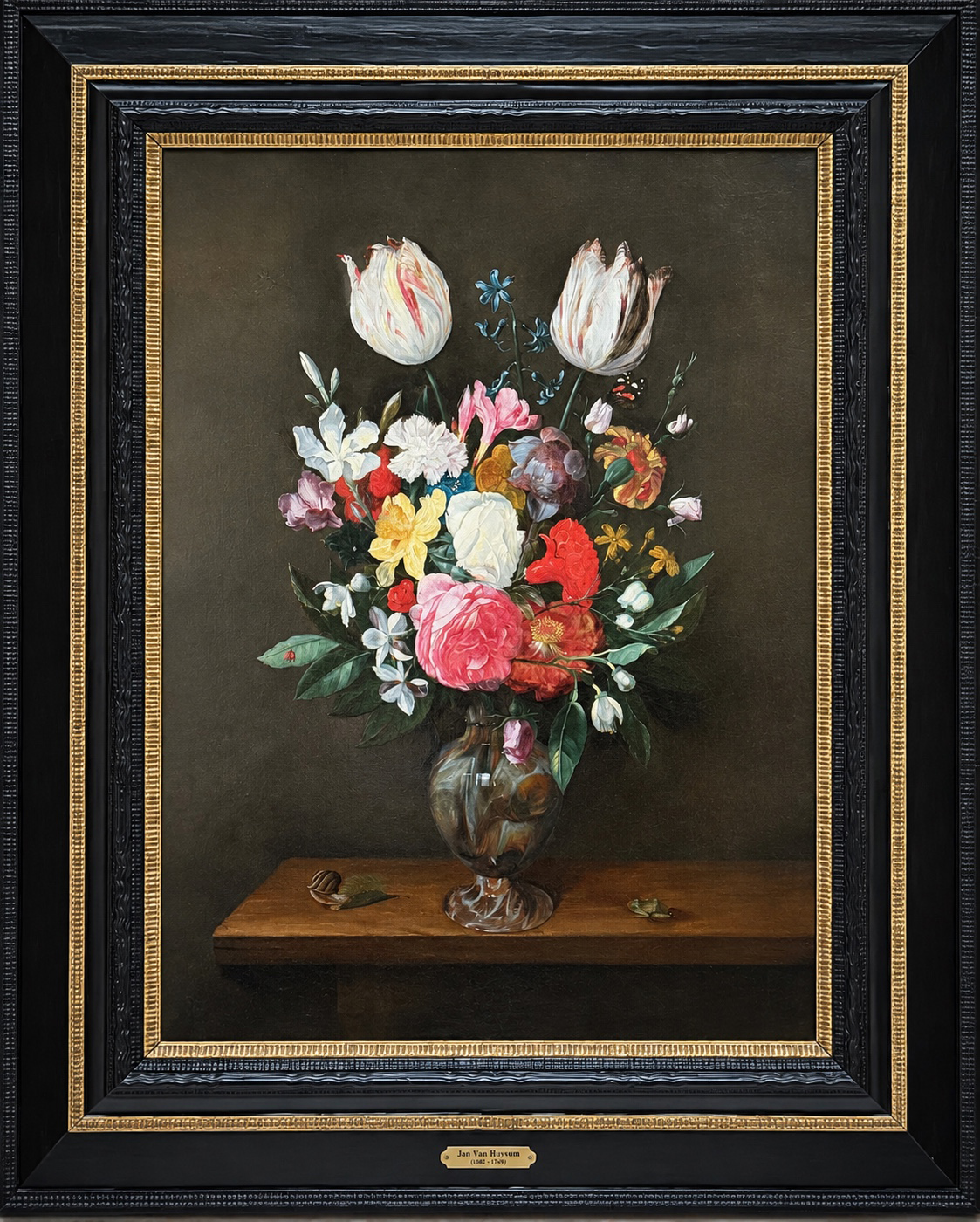
His compositions reveal the sophisticated tradition of Flemish still-life painting, combining carefully observed flowers with precious vessels and other objects. His work demonstrates the seventeenth-century fascination with rare botanical specimens and luxurious materials. A flower still life by Van den Hecke the Elder was restored by Fondation Custodia in Paris and is now part of its permanent collection.
Of particular interest in the present still life is the calcedonio glass vase. Calcedonio, or chalcedony glass, is one of the distinctive achievements of Venetian glassmaking. It is a richly marbled glass designed to imitate the appearance of chalcedony and other banded semi-precious stones such as agate. According to the Corning Museum of Glass, calcedonio was first produced in Venice in the late fifteenth century. The technique involved creating complex veins of colour within the glass, using metallic oxides and carefully controlled mixtures.
The Victoria and Albert Museum dates the development of a special form of calcedonio in Venice to around 1460, noting that the technique required complex heat treatment and remained a closely guarded Venetian secret for centuries. The Museo del Vetro in Murano likewise describes chalcedony glass as a Renaissance Venetian invention made from mixtures of coloured, white and opal glass and other substances, producing its characteristic multicoloured veining.
The extraordinary rarity and technical difficulty of this glass made it an especially appropriate object for the luxury still-life tradition of the seventeenth century. A contemporary example, a Calcedonio Pitcher dating from around 1500–1525, is preserved in the collection of the Corning Museum of Glass, while the Metropolitan Museum of Art in New York holds a later Venetian/Murano perfume bottle in chalcedony and aventurine glass.
The inclusion of such a remarkable vessel in Van den Hecke’s floral compositions reflects the seventeenth-century fascination with rare flowers, precious materials and objects of exceptional craftsmanship, bringing together the worlds of natural beauty, artistic virtuosity and luxury.
Works by Jan van den Hecke the Elder are represented in, among others:
Zeedijk – Het Zoute 731, 8300 Knokke
Belgium
+32 478 22 65 64
info@valentinasafarian.com
© Copyright 2023 Valentina Safarian | Website by BEAUX SITES