Sint-Jans-Molenbeek 1868 – 1940 Brussels
Belgian Painter, Watercolourist, Illustrator and Printmaker
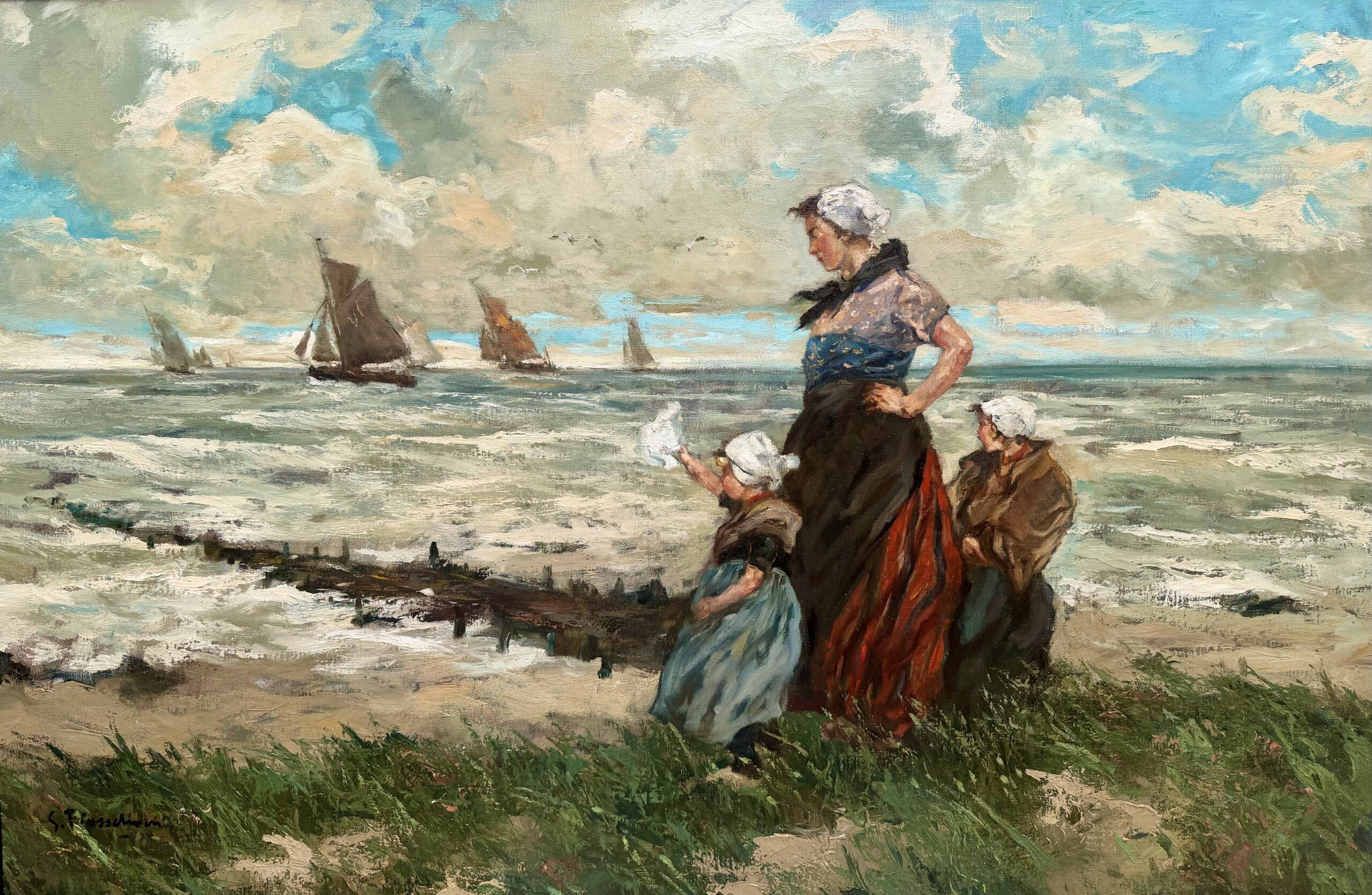
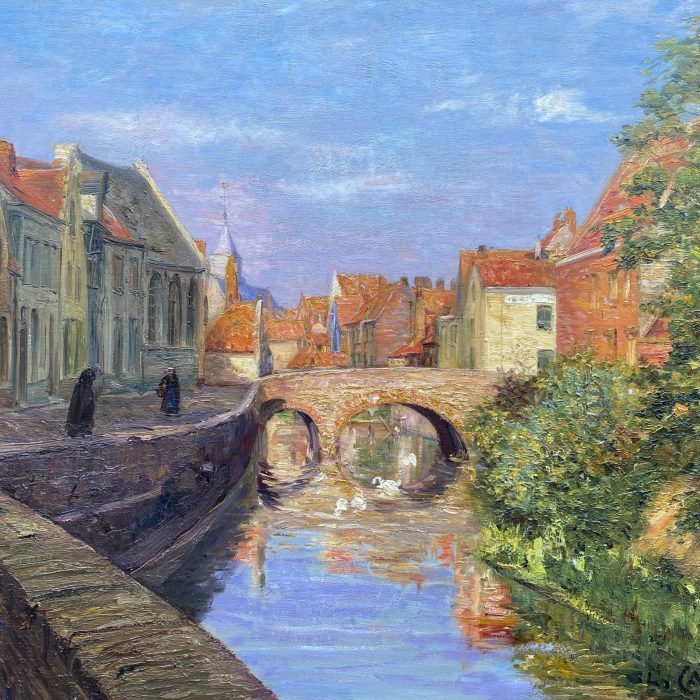
Départ pour la pêche – Departure for Fishing
Gustave Flasschoen (1868–1940) was a versatile Belgian painter, watercolourist, illustrator, and graphic artist whose career spanned the late nineteenth and early twentieth centuries. Celebrated for his evocative landscapes, genre scenes, and Orientalist compositions, he combined refined draughtsmanship with a luminous Impressionist palette, creating works distinguished by their elegance, vitality, and keen observation of everyday life.
Born in Sint-Jans-Molenbeek near Brussels, Flasschoen studied between 1887 and 1890 at the Académie des Beaux-Arts in Molenbeek under François Stroobant and further refined his artistic training with the painter Van Dyck in Schaerbeek. He initially established himself as a designer of posters and book illustrations, working for leading Belgian newspapers and illustrated magazines, including La Dernière Heure, Le Petit Bleu, L’Illustration, Le Globe Illustré, and Pourquoi Pas?. His illustrations also appeared in numerous literary publications devoted to the legends and history of Belgium.
Flasschoen achieved lasting recognition in 1909 when he designed the iconic promotional poster for the newly founded seaside resort of Knokke-Le Zoute. His celebrated composition, La Femme, depicting an elegant Belle Époque lady seated atop a dune with a flowing green scarf, became one of the most famous Belgian tourist posters of the twentieth century. Reproduced as lithographs, chromolithographs, postcards, and brochure covers, more than 250,000 copies were printed, securing its place as an enduring symbol of the Belgian coast.
An enthusiastic traveller, Flasschoen journeyed extensively throughout Europe, Russia, and Argentina before the First World War. During the interwar years he made numerous study trips to Spain and North Africa, where the landscapes, architecture, horses, and vibrant local life inspired a distinguished body of Orientalist paintings. Executed with fluid brushwork, elegant linearity, and a bright, harmonious palette, these works established him as one of Belgium’s accomplished Orientalist painters. In 1930 he exhibited his Moroccan, Algerian, and Tunisian paintings in Antwerp to considerable acclaim.
Alongside his travel-inspired works, Flasschoen painted intimate rural landscapes, animated townscapes, fishing scenes, spirited equestrian subjects, and humorous genre compositions. The First World War profoundly affected him, inspiring the powerful work Les Masques, depicting soldiers emerging through clouds of poison gas wearing gas masks, now preserved in the Royal Museum of the Armed Forces and Military History in Brussels.
Although he never affiliated himself with a particular artistic movement, Flasschoen developed a highly personal style that evolved towards an expressive form of Impressionist Realism, balancing atmospheric light with careful observation and accomplished draftsmanship. His independence, technical versatility, and wide-ranging subject matter earned him an esteemed place within Belgian art of the early twentieth century.
Today, his works are held in several important public collections, including the Museum of Ixelles, the Royal Museum of the Armed Forces and Military History in Brussels, the Royal Library of Belgium, and the Vleeshuis Museum in Antwerp. His celebrated Knokke poster and his accomplished Orientalist paintings continue to be among the finest achievements of his artistic legacy.