Paal 1923 – 2006 Pellenberg
Belgian Painter
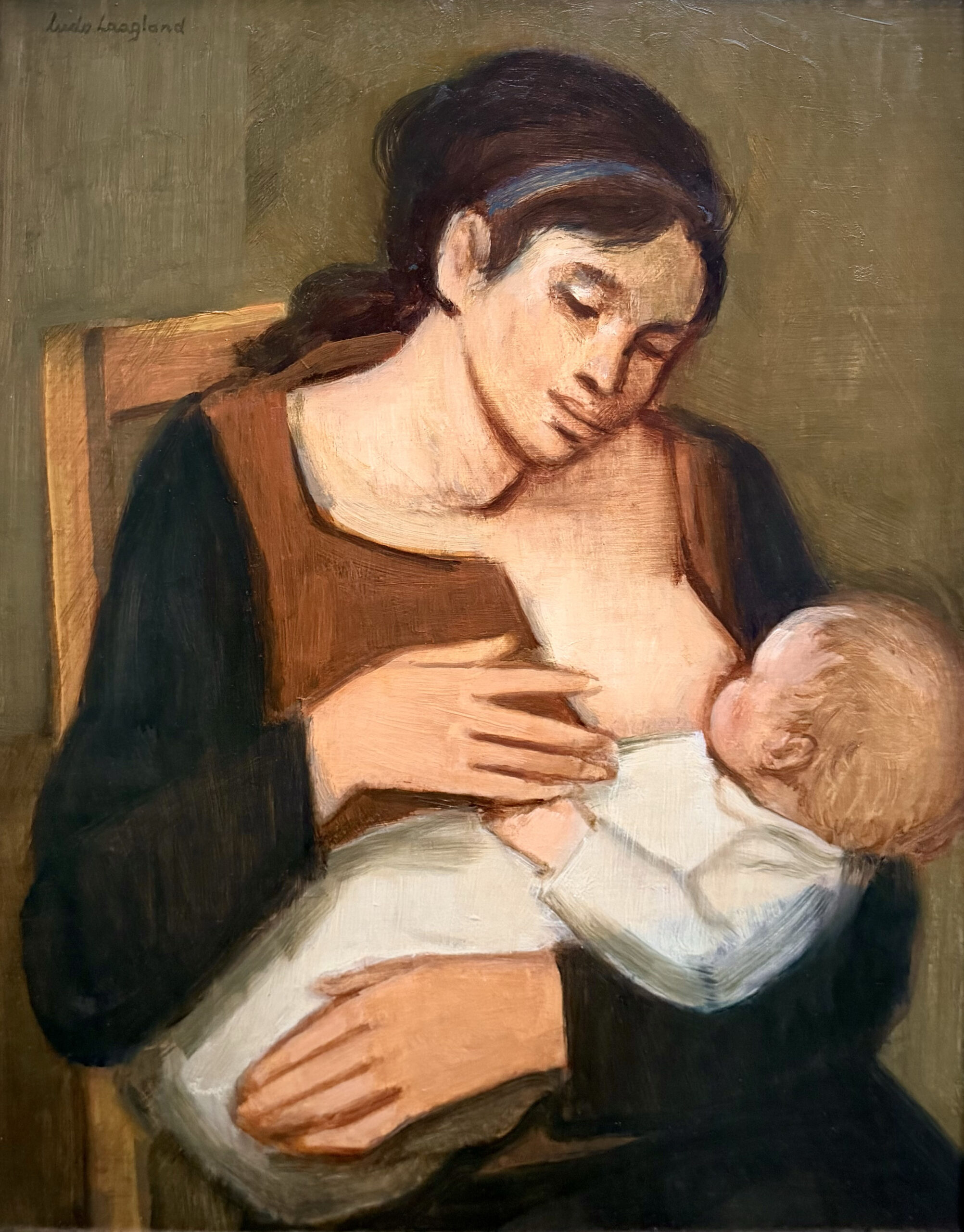
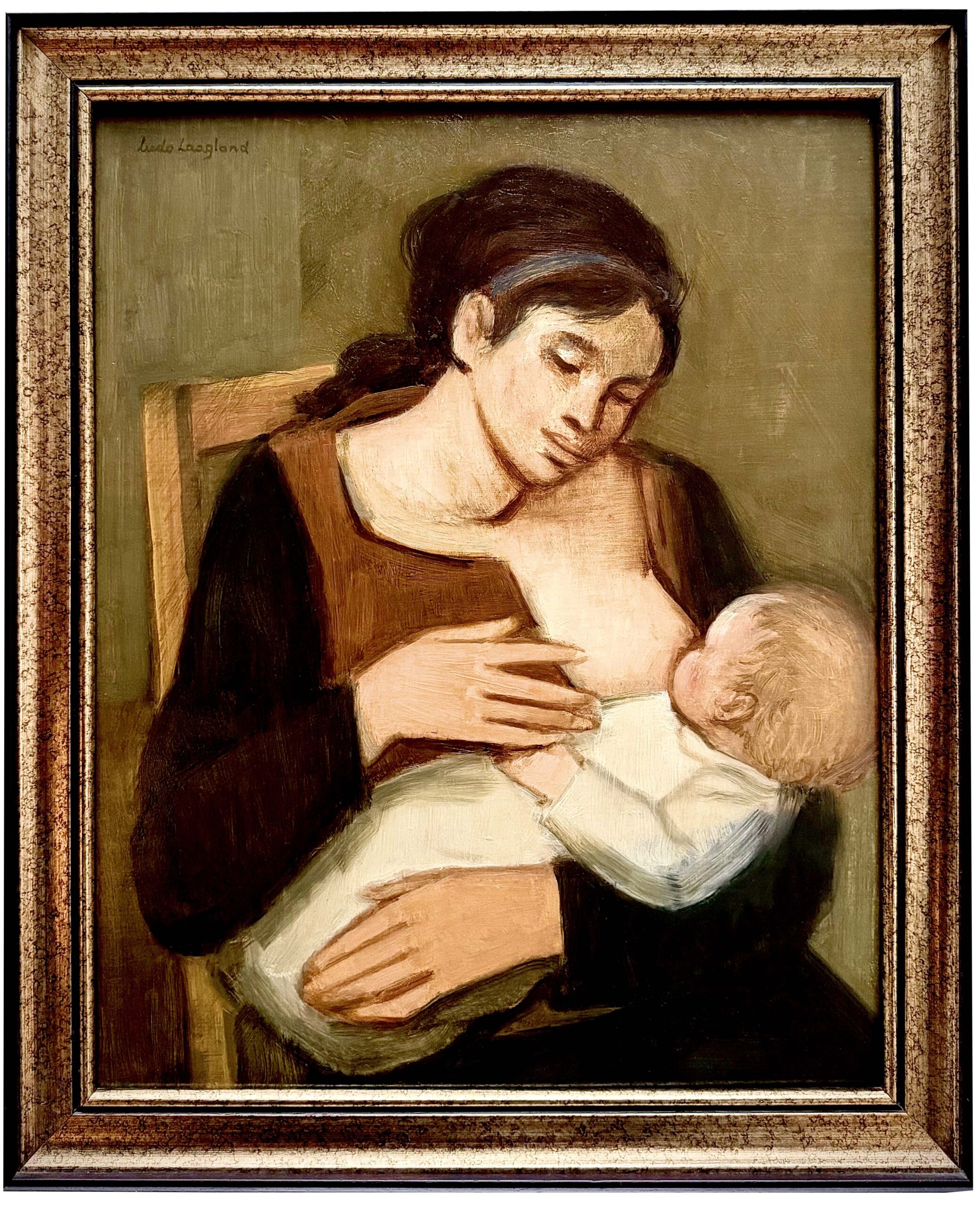
Mother and Child
Ludo Laagland was born in Paal on 7 May 1923 and was a Belgian painter known for his sincere and steadfast commitment to figurative art in a century increasingly dominated by abstraction.
From an early age, Laagland felt called to become a painter. At just ten or twelve years old, he already knew that art would define his life, as it felt entirely natural to him. Born in Paal in 1923, he began his formal studies in 1937 at the Teacher Training College in Maasmechelen, where he obtained his diploma as a primary school teacher in 1942. Despite this qualification, he never entered the teaching profession, choosing instead to dedicate himself fully to painting.
During his studies, he became acquainted with the son of the painter Gaston Wallaert, a connection that would prove significant. He later attended the Higher Institute in Antwerp, where he worked from live models. Although he received academic training, Laagland may largely be considered an autodidact, developing a personal style shaped above all by direct observation of nature.
He frequently visited the studio of Gaston Wallaert in Hasselt and, in 1949, met Broeder Max. Painting soon became his lifelong profession. In the decades following the Second World War, a period when many artists embraced abstraction and experimentation, Laagland remained faithful to an honest, simple, and expressive figurative style.
In the 1950s, he undertook several formative journeys to Paris, Spain, Portugal, Italy, Sicily, and, in 1958, to Yugoslavia and Greece together with the artist Staf Beerten. Travel broadened his artistic horizon while reinforcing his devotion to landscape and the human figure.
Laagland’s oeuvre is remarkably diverse. In addition to landscapes, he produced portraits, still lifes, nudes, and religious works. He painted numerous commissioned portraits of prominent cultural figures, including Stijn Streuvels, Ernest Claes, Gerard Walschap, Albert Servaes, and Achiel Van Acker. His religious works include several Stations of the Cross, portraits of Christ, The Kiss of Judas, Pietà, The Prodigal Son, and The Flight into Egypt. He also designed stained-glass windows, notably for the chapel of St Ursula Hospital in Herk-de-Stad.
Laagland did not hesitate to work on a monumental scale. He created murals for public spaces such as cafés, including the large mural in the student café Ambiorix at the Oude Markt in Leuven. In Herk-de-Stad, where he lived for many years, he painted a mural for café De Volksmacht, today hidden behind a false wall following later renovations. In 1960, he completed a monumental mural in the parish hall café in Bocholt to commemorate the 50th anniversary of the Bocholter Tower Relocation of 1910.
Laagland began exhibiting individually as early as 1944 and participated in numerous group exhibitions from 1953 onward. His work was shown, among others, in Maastricht in 1955 Art from Belgian Limburg and in Hasselt in 1957 Post War Art in Limburg.
His paintings are held in private collections both in Belgium and internationally, including Germany, Italy, Denmark, the Netherlands, Greece, the United States, and Austria. Works by Laagland were also acquired by the Belgian State and the Province of Limburg.
Ludo Laagland passed away in Pellenberg on 24 March 2006. He remains cherished by collectors for the authenticity, warmth, and quiet strength of his art.