Antwerp 1887 – 1972 Schoten
Belgian Painter
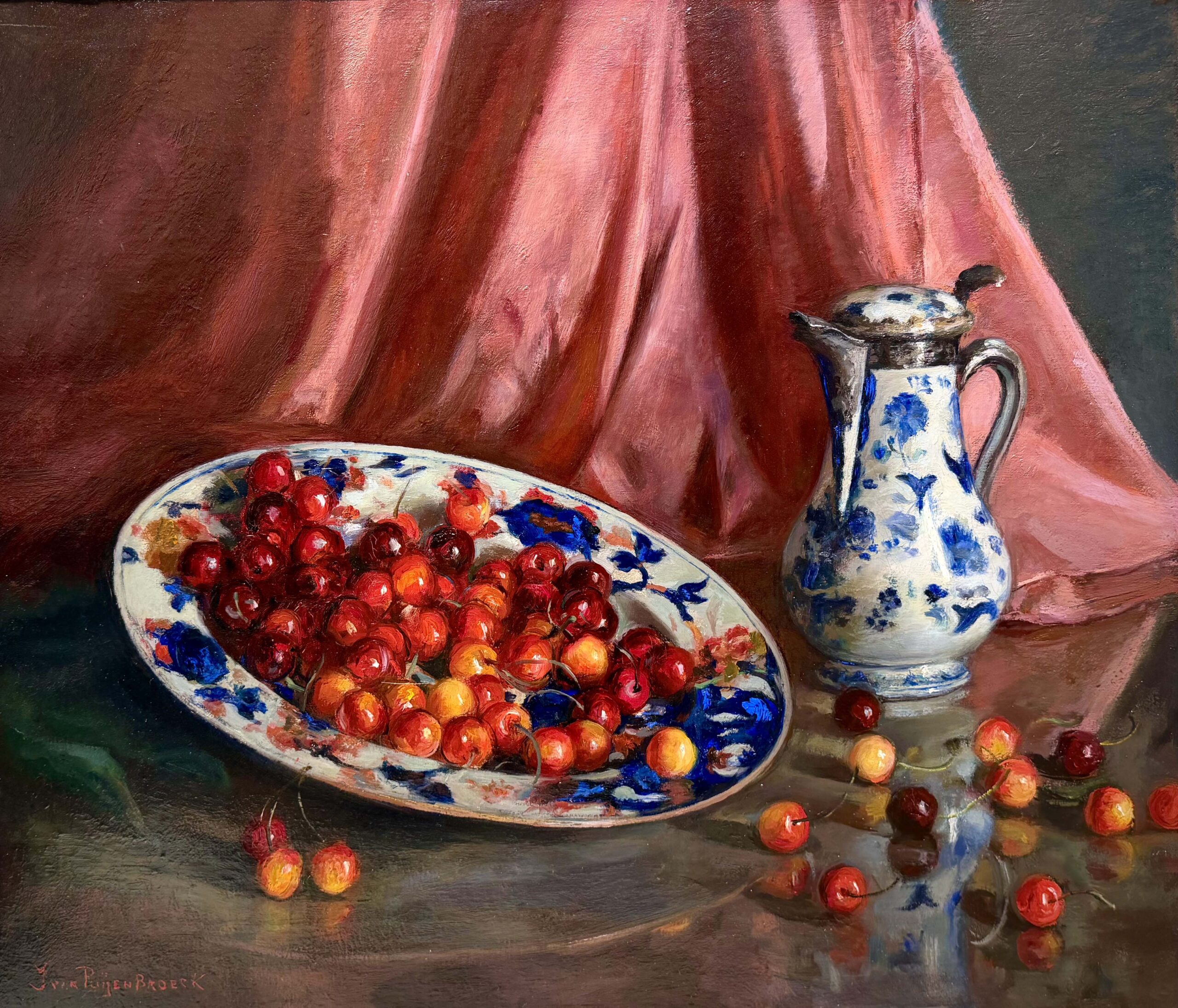
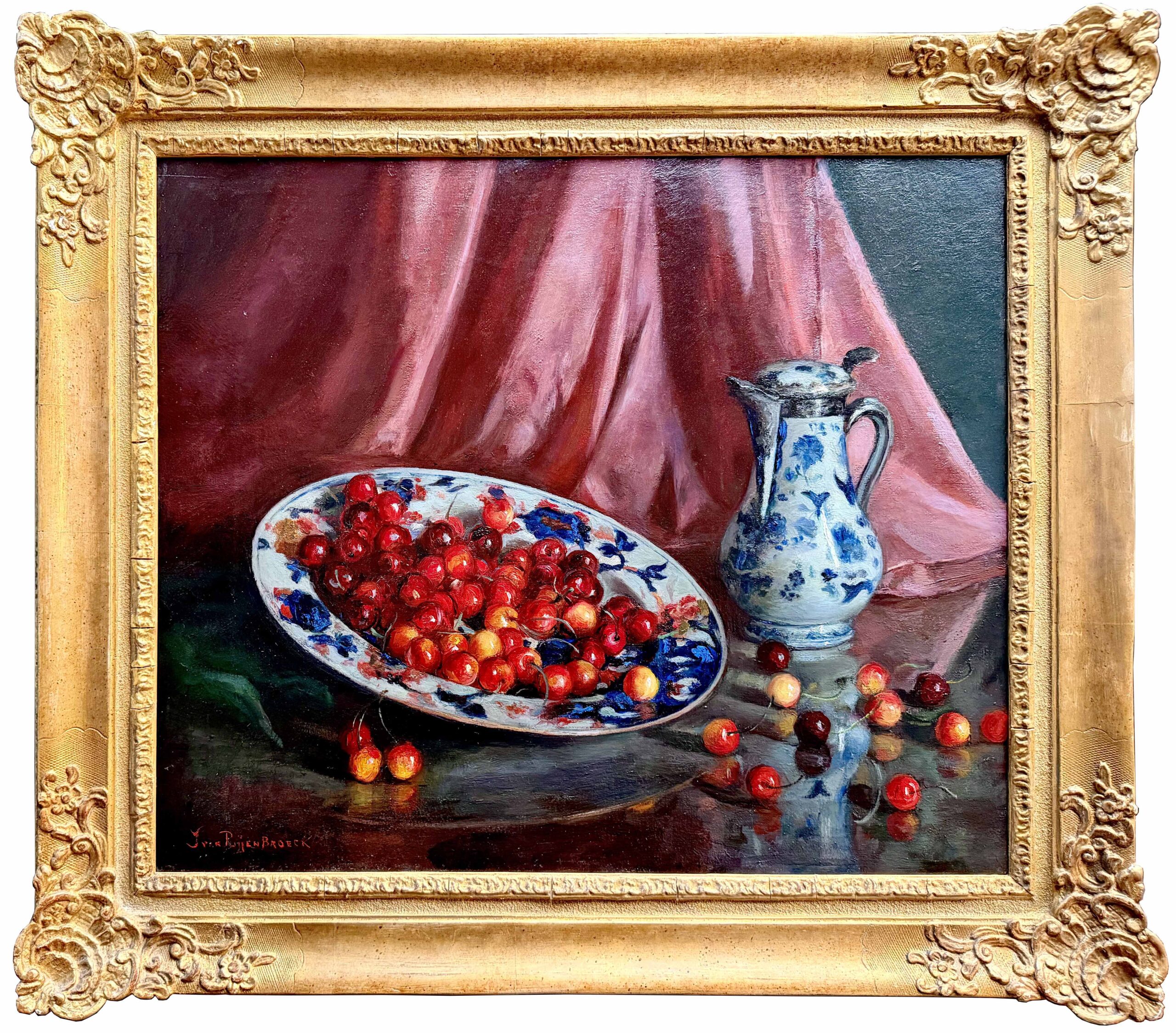
Still Life with Cherries
Jan Van Puyenbroeck (Antwerp, 5 December 1887 – Schoten, 3 November 1972) was a Belgian painter, poet, and author, best known for his still lifes, portraits, nudes, religious subjects, and landscapes. He usually signed his paintings “J. van Puyenbroeck.”
Van Puyenbroeck was born in Antwerp as the eldest son in a family of fourteen children. Because he had to contribute to the family’s livelihood, he was initially unable to pursue formal studies. On the advice of the artist Alfred Ost, he enrolled in evening classes at the Royal Academy of Fine Arts in Antwerp.
In 1908 he was admitted to the Higher Institute of Fine Arts, where he befriended the painter Alphons de Cuyper. His talent was recognized early: in 1910 he placed second in the Prix de Rome competition, and in 1913 he won the Prize of the City of Antwerp for Painting.
During the First World War, Van Puyenbroeck fled via England to Dutch Limburg. There he met the Dutch artist Willem van Konijnenburg, with whom he developed a close friendship. According to art historian Dirk Vansina, Van Puyenbroeck remained in the Netherlands for about four years.
In South Limburg he played an important role in what later became known as the Meerssen School, a collective of young painters who received instruction in the oil mill at Rothem, near Meerssen. Among his pupils were Jos Tielens, Alphons Volders, Charles Eyck, Herman Koch, and Harry Koolen. Willem van Konijnenburg was also closely involved with this group; Eyck later recalled that his first lessons in perspective came from Van Konijnenburg at the church in Meerssen, which at that time had not yet been designated a basilica.
The friendship between Van Puyenbroeck and Van Konijnenburg left several artistic traces. During a visit by Van Puyenbroeck to Willem and his wife Netty at the De Raarhof estate in Raar (near Meerssen), Van Konijnenburg drew a portrait of him, now in the collection of the Drents Museum in Assen and bearing the inscription “Met groote waardering” (“With great appreciation”). A small drawn portrait of Van Puyenbroeck is also included in Getekend dagboek (vol. 21, 1916–1917) at Kunstmuseum The Hague.
After the war, travel remained central to Van Puyenbroeck’s artistic development. In 1921 he journeyed to Spain, and in the 1930s undertook study trips to Italy, England, Austria, and Germany. Despite this international orientation, Limburg continued to be a lasting source of inspiration for him. In 1953 he told the Gazet van Limburg:
“I have travelled a great deal, but Limburg is still for me a marvel of beauty.”
Alongside his work as a painter, Van Puyenbroeck was active as a teacher. He taught, among others, Aart Hendricus Baars, Paul Daenen, Julie Herfst-Alard, Hermana Carolina Timmer, and André Van den Sande.
In 1932 he worked as a restorer for the treasury of St Servatius’ Church in Maastricht, where he restored “a large number of paintings” for the opening of the museum of ecclesiastical art on 18 July that year.
Van Puyenbroeck exhibited widely in Belgium and the Netherlands. As early as 1918 and 1921, retrospective exhibitions of his work were held in Maastricht and Liège. In the decades that followed, he showed at venues in The Hague, Antwerp, and Maastricht, including the Royal Art Gallery Kleykamp (1937 and 1938), the Stedelijk Museum Maastricht (1932), and the Stedelijk Kunstsalon Antwerp (1943).
Later, his oeuvre was revisited in thematic and posthumous exhibitions such as Doordrongen van leven (Museum Kempenland, Eindhoven, 1988), Limburgia Exotica (Limburgs Museum, Venlo, 2007–2008), and The Five of Schoten (Kasteel van Schoten, 2022).
Works by Jan Van Puyenbroeck are held in the collections of the Bonnefanten Museum in Maastricht and the Limburgs Museum in Venlo.